
HILIC HPLC Columns
USHD HILIC HPLC Columns
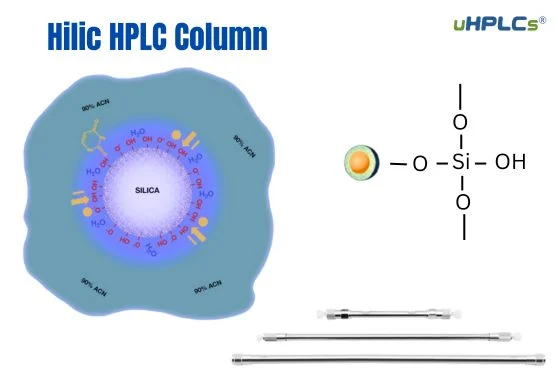
USHD HILIC columns retain polar and hydrophilic compounds that elute too early on a reversed-phase C18 column. The mobile phase is high in organic solvent, with a smaller aqueous portion.
Three phases are listed: HILIC-SiO2 (USP L3, pH 2–8), HILIC-Amide (USP L68, pH 2–9) and HILIC-ZIL, the zwitterionic phase (pH 2–9).
USHD HILIC HPLC column
Column Overview
Product videos for the USHD HILIC columns, including how HILIC compares with reversed phase.
HILIC HPLC Columns by uHPLCs
HILIC Column
Normal phase vs reversed phase
Features
Three HILIC phases for polar compounds that are poorly retained on C18. Selectivity is the difference.
- USHD HILIC-SiO2 — USP L3, 120 Å, 320 m²/g, 6% carbon, pH 2–8. Listed at 5 μm, 3 μm and 1.8 μm. Hydrophilic silica for water-soluble and highly polar compounds. The published note also allows reversed-phase use.
- USHD HILIC-Amide — USP L68, 120 Å, 320 m²/g, 5% carbon, pH 2–9. Selectivity similar to an amino HILIC column, with the published claim of a longer column life. Catalog sizes run from 5 μm to 1.8 μm, including 2.5 μm.
- USHD HILIC-ZIL — Zwitterionic groups for acidic, basic and zwitterionic solutes. Published row: 5 μm, 100 Å, 400 m²/g, 6% carbon, pH 2–9, and a 100% aqueous mobile phase is listed as usable. The sheet also lists 3 μm, 2.5 μm and 1.8 μm at 120 Å.
- Mass spectrometry — The current page describes these columns for LC-MS and LC-MS/MS, with a high-organic mobile phase and low bleed called out as the reason.
Product Selection
Choose the phase from the analyte. SiO2 is the silica HILIC phase. Amide is the bonded alternative to an amino column. ZIL is the zwitterionic phase.
HILIC-ZIL
Zwitterionic, 100 Å and 120 Å
pH 2–9 · 5 μm at 100 Å · 3, 2.5 and 1.8 μm at 120 Å
View catalog →
Specifications
Surface area, carbon load and pH are the figures on the current specification table. Dimensions and catalog numbers are from the selection sheet.
| Phase | USP | Particle size | Pore size | Surface area | Carbon load | pH |
|---|---|---|---|---|---|---|
| USHD HILIC-SiO2 | L3 | 5 μm, 3 μm, 1.8 μm | 120 Å | 320 m²/g | 6% | 2–8 |
| USHD HILIC-Amide | L68 | 5 μm, 3 μm, 2.5 μm, 1.8 μm | 120 Å | 320 m²/g | 5% | 2–9 |
| USHD HILIC-ZIL | — | 5 μm; 3 μm, 2.5 μm, 1.8 μm | 100 Å at 5 μm; 120 Å at 3, 2.5 and 1.8 μm | 400 m²/g | 6% | 2–9 |
The published ZIL row is 5 μm and 100 Å. Surface area, carbon load and pH on that row are shown above. The 120 Å ZIL sizes are on the selection sheet.
USHD HILIC-SiO2 catalog
25 standard sizes. 4.6×250 mm is listed at 5 μm only.
| Catalog No. | Dimension | Particle size | Pore size |
|---|---|---|---|
| P1F0B-00437 | 2.1×50 mm | 5 μm | 120 Å |
| P1F0B-00438 | 2.1×100 mm | 5 μm | 120 Å |
| P1F0B-00439 | 3.0×50 mm | 5 μm | 120 Å |
| P1F0B-00440 | 3.0×100 mm | 5 μm | 120 Å |
| P1F0B-00441 | 4.6×50 mm | 5 μm | 120 Å |
| P1F0B-00442 | 4.6×100 mm | 5 μm | 120 Å |
| P1F0B-00443 | 4.6×150 mm | 5 μm | 120 Å |
| P1F0B-00444 | 4.6×250 mm | 5 μm | 120 Å |
| P1F0B-00429 | 2.1×50 mm | 3 μm | 120 Å |
| P1F0B-00430 | 2.1×100 mm | 3 μm | 120 Å |
| P1F0B-00763 | 2.1×150 mm | 3 μm | 120 Å |
| P1F0B-00431 | 3.0×50 mm | 3 μm | 120 Å |
| P1F0B-00432 | 3.0×100 mm | 3 μm | 120 Å |
| P1F0B-00764 | 3.0×150 mm | 3 μm | 120 Å |
| P1F0B-00433 | 4.6×50 mm | 3 μm | 120 Å |
| P1F0B-00434 | 4.6×100 mm | 3 μm | 120 Å |
| P1F0B-00435 | 4.6×150 mm | 3 μm | 120 Å |
| P1F0B-00421 | 2.1×50 mm | 1.8 μm | 120 Å |
| P1F0B-00422 | 2.1×100 mm | 1.8 μm | 120 Å |
| P1F0B-00765 | 2.1×150 mm | 1.8 μm | 120 Å |
| P1F0B-00423 | 3.0×50 mm | 1.8 μm | 120 Å |
| P1F0B-00424 | 3.0×100 mm | 1.8 μm | 120 Å |
| P1F0B-00766 | 3.0×150 mm | 1.8 μm | 120 Å |
| P1F0B-00425 | 4.6×50 mm | 1.8 μm | 120 Å |
| P1F0B-00426 | 4.6×100 mm | 1.8 μm | 120 Å |
USHD HILIC-Amide catalog
14 standard sizes, all 120 Å. 4.6×250 mm is listed at 5 μm only. P1F0B-00817 and P1F0B-00819 are both listed as 2.5 μm, 2.1×50 mm.
| Catalog No. | Dimension | Particle size | Pore size |
|---|---|---|---|
| P1F0B-00814 | 3.0×150 mm | 5 μm | 120 Å |
| P1F0B-00342 | 4.6×150 mm | 5 μm | 120 Å |
| P1F0B-00405 | 4.6×250 mm | 5 μm | 120 Å |
| P1F0B-00798 | 2.1×150 mm | 3 μm | 120 Å |
| P1F0B-00815 | 3.0×100 mm | 3 μm | 120 Å |
| P1F0B-00566 | 3.0×150 mm | 3 μm | 120 Å |
| P1F0B-00567 | 4.6×150 mm | 3 μm | 120 Å |
| P1F0B-00817 | 2.1×50 mm | 2.5 μm | 120 Å |
| P1F0B-00818 | 2.1×100 mm | 2.5 μm | 120 Å |
| P1F0B-00819 | 2.1×50 mm | 2.5 μm | 120 Å |
| P1F0B-00731 | 2.1×100 mm | 1.8 μm | 120 Å |
| P1F0B-00820 | 2.1×150 mm | 1.8 μm | 120 Å |
| P1F0B-00821 | 3.0×100 mm | 1.8 μm | 120 Å |
| P1F0B-00822 | 3.0×150 mm | 1.8 μm | 120 Å |
USHD HILIC-ZIL catalog
13 standard sizes. 5 μm is 100 Å. 3 μm, 2.5 μm and 1.8 μm are 120 Å. 4.6×250 mm is listed at 5 μm only.
| Catalog No. | Dimension | Particle size | Pore size |
|---|---|---|---|
| P1F0B-00823 | 3.0×150 mm | 5 μm | 100 Å |
| P1F0B-00343 | 4.6×150 mm | 5 μm | 100 Å |
| P1F0B-00404 | 4.6×250 mm | 5 μm | 100 Å |
| P1F0B-00824 | 2.1×150 mm | 3 μm | 120 Å |
| P1F0B-00825 | 3.0×100 mm | 3 μm | 120 Å |
| P1F0B-00816 | 3.0×150 mm | 3 μm | 120 Å |
| P1F0B-00826 | 4.6×150 mm | 3 μm | 120 Å |
| P1F0B-00827 | 2.1×100 mm | 2.5 μm | 120 Å |
| P1F0B-00828 | 4.6×150 mm | 2.5 μm | 120 Å |
| P1F0B-00799 | 2.1×100 mm | 1.8 μm | 120 Å |
| P1F0B-00801 | 2.1×150 mm | 1.8 μm | 120 Å |
| P1F0B-00829 | 3.0×100 mm | 1.8 μm | 120 Å |
| P1F0B-00830 | 3.0×150 mm | 1.8 μm | 120 Å |
Applications
Uses already described on this page: polar analytes that reversed phase does not hold, plus the selectivity of each phase.
Polar drugs and metabolites
Amino acids, nucleotides, sugars, peptides and small polar drugs that elute too early on C18.
SiO2, including reversed phase
Water-soluble compounds and strongly basic polar compounds. The published note says the phase can also be used in reversed-phase mode.
Amide instead of amino
Acidic and highly polar compounds, and mixtures often separated on an amino phase in a low-pH buffer.
Zwitterionic samples
Acidic, basic and zwitterionic solutes on HILIC-ZIL, including basic drugs weakly retained in reversed phase.
LC-MS
The current page points these columns at LC-MS and LC-MS/MS because the high-organic mobile phase and low bleed suit mass spectrometry.
100% aqueous on ZIL
The published ZIL note says a fully aqueous mobile phase can be used, and that the phase stays highly hydrophilic.
Related: USHD C18 HPLC columns · USHD SEC columns · All HPLC columns.
Support
Send the phase and catalog number if you have them. Otherwise send the analyte type, current column and mobile phase.
Phase selection
SiO2 for general polar retention, Amide when an amino-like selectivity is needed, ZIL for acidic, basic or zwitterionic solutes.
Catalog confirmation
The tables above are the standard list. We confirm the P1F0B number against phase, dimensions, particle size and pore size before quoting.
Custom sizes
Dimensions that are not in the catalog can be requested as a custom packed column.
FAQ
Answers from the current HILIC page and the selection sheet.
01 What is a HILIC column?
HILIC is hydrophilic interaction liquid chromatography. The stationary phase is polar, and the mobile phase is high in organic solvent with a smaller aqueous portion. Polar compounds that elute too early on a reversed-phase C18 column are retained more strongly. More polar analytes generally elute later than less polar ones.
02 How do SiO2, Amide and ZIL differ?
USHD HILIC-SiO2 is a hydrophilic silica phase, USP L3, 120 Å, pH 2–8, 320 m²/g, 6% carbon. USHD HILIC-Amide is an amide phase, USP L68, 120 Å, pH 2–9, 320 m²/g, 5% carbon. USHD HILIC-ZIL is a zwitterionic phase. The published row is 5 μm, 100 Å, 400 m²/g, 6% carbon, pH 2–9. The selection sheet also lists ZIL at 3 μm, 2.5 μm and 1.8 μm, 120 Å.
03 What mobile phase does the current page describe?
The page describes a high-acetonitrile mobile phase with a smaller water or methanol portion, the opposite of a typical reversed-phase gradient. Raising the organic content increases retention. A water-rich layer on the polar phase is what retains hydrophilic analytes.
04 What is USHD HILIC-SiO2 used for?
Water-soluble and highly polar compounds separated by polarity, including strongly basic polar compounds under HILIC conditions. The published note also says it can be used in reversed-phase mode, and that the silica treatment is intended for stability and column life. Catalog sizes are 5 μm, 3 μm and 1.8 μm, all 120 Å.
05 What is USHD HILIC-Amide used for?
The published description compares it with an amino HILIC column: similar separation ability, different selectivity, and a longer column life. It retains highly polar ionic compounds in a high-organic mobile phase, and separates acidic and highly polar compounds, including some mixtures often run on an amino phase in a low-pH buffer.
06 What is USHD HILIC-ZIL used for?
A zwitterionic HILIC phase for solutes that are acidic, basic, or zwitterionic. The published note says it is highly hydrophilic, can use a 100% aqueous mobile phase, and retains highly polar ionic compounds and basic drugs that are weakly retained in reversed phase.
07 Which catalog number is the 4.6×250 mm column?
USHD HILIC-SiO2, 5 μm, 120 Å, 4.6×250 mm is P1F0B-00444. USHD HILIC-Amide, 5 μm, 120 Å, 4.6×250 mm is P1F0B-00405. USHD HILIC-ZIL, 5 μm, 100 Å, 4.6×250 mm is P1F0B-00404. The other particle sizes on this sheet do not list a 4.6×250 mm size.
08 Can other dimensions be made?
The tables are the standard catalog. Other internal diameters and lengths can be requested as a custom column.
Need a phase matched to your analyte?
Request a USHD HILIC Quote
Send the catalog number, or the phase, particle size, pore size and dimensions. We will confirm availability and pricing.
Helpful to include:
- Phase (SiO2, Amide or ZIL)
- Catalog number, if it is in the table
- Particle size, pore size and dimensions
- Analyte type and current column, if you want a recommendation
Prefer email? [email protected] · Contact Us