
Normal Phase HPLC Columns
USHD Normal Phase HPLC Columns
Normal phase uses a polar stationary phase and a non-polar mobile phase. More polar compounds are retained longer. It is the option when a reversed-phase C18 column does not hold the analyte, or when isomers need a different selectivity.
The specification table lists USHD SiO2 (USP L3) and USHD CN (USP L10), both 5 μm, 120 Å, pH 2–8. The page also describes amino and diol phases. Catalog numbers on this page are the SiO2 and CN sizes from the selection sheet.
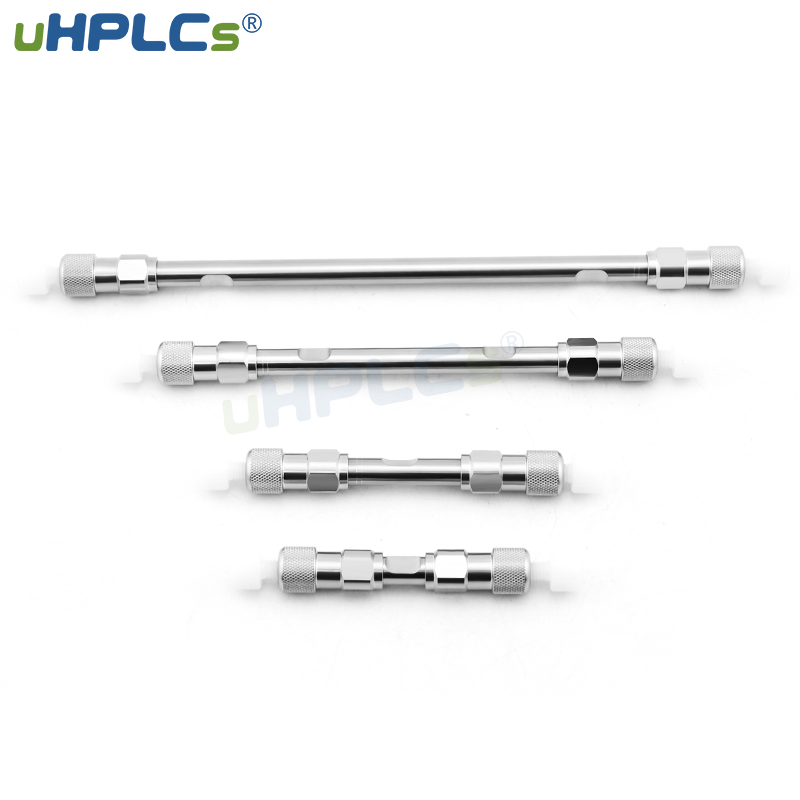
USHD SiO2
Column Overview
The two videos already on this page: how normal phase compares with reversed phase.
Normal vs Reverse Phase Chromatography Column 101 – HPLC Class 01
Features
Polar stationary phases for compounds that a reversed-phase C18 column does not hold, or that need isomer selectivity.
- USHD SiO2 — Unbonded ultra-pure spherical silica, USP L3, 5 μm, 120 Å, 200 m²/g, pH 2–8. Published metal impurities are below 10 ppm. Carbon load is not listed.
- USHD CN — Cyanopropyl phase, USP L10, 5 μm, 120 Å, 320 m²/g, 7% carbon, pH 2–8. Medium polarity. The page says it can be used in normal phase and reversed phase.
- NH2 and diol — Described on the current page for sugars, carbohydrates, lipids, and polar metabolites. They are not on the selection sheet, so no catalog numbers are listed here.
- Retention order — In normal phase, more polar analytes are retained longer. Typical solvents are hexane or heptane, with isopropanol, methanol, or ethanol as a modifier.
| Normal phase | Reversed phase | |
|---|---|---|
| Stationary phase | Polar | Non-polar |
| Mobile phase | Non-polar | Polar |
| Best for | Polar compounds | Non-polar compounds |
Product Selection
The specification table and the selection sheet cover USHD SiO2 and USHD CN. NH2 and diol are described on the current page without catalog numbers.
NH2
Sugars and carbohydrates
Described for sugar analysis, carbohydrates, and polar organic compounds. No catalog row on this sheet.
Diol
More stable than bare silica
Described for lipids, polar metabolites, and natural-product purification. No catalog row on this sheet.
Specifications
Surface area, carbon load, and pH are the figures on the current specification table. Every catalog size below is 5 μm and 120 Å. The six dimensions match the table and the selection sheet.
| Phase | USP | Particle size | Pore size | Surface area | Carbon load | pH |
|---|---|---|---|---|---|---|
| USHD SiO2 | L3 | 5 μm | 120 Å | 200 m²/g | — | 2–8 |
| USHD CN | L10 | 5 μm | 120 Å | 320 m²/g | 7% | 2–8 |
The SiO2 carbon-load cell on the current table is blank. Both phases list 4.6×250, 4.6×150, 4.6×100, 4.6×50, 3.0×100, and 3.0×50 mm.
USHD SiO2 catalog
6 standard sizes. Ultra-pure spherical silica, metal impurities below 10 ppm. Used for structural isomers, highly polar compounds that tail, basic organics, fat-soluble compounds, vitamins, steroids, and drug molecules.
| Catalog No. | Dimension | Particle size | Pore size |
|---|---|---|---|
| P1F0B-00503 | 3.0×50 mm | 5 μm | 120 Å |
| P1F0B-00504 | 3.0×100 mm | 5 μm | 120 Å |
| P1F0B-00505 | 4.6×50 mm | 5 μm | 120 Å |
| P1F0B-00506 | 4.6×100 mm | 5 μm | 120 Å |
| P1F0B-00507 | 4.6×150 mm | 5 μm | 120 Å |
| P1F0B-00508 | 4.6×250 mm | 5 μm | 120 Å |
USHD CN catalog
6 standard sizes. Cyanopropyl phase. In reversed phase, selectivity differs from C18, strongly basic compounds have better peak shape, and the phase is more compatible with a high proportion of water. When a compound will not elute from C18 or C8, the page points to the cyano column.
| Catalog No. | Dimension | Particle size | Pore size |
|---|---|---|---|
| P1F0B-00498 | 3.0×50 mm | 5 μm | 120 Å |
| P1F0B-00499 | 3.0×100 mm | 5 μm | 120 Å |
| P1F0B-00500 | 4.6×50 mm | 5 μm | 120 Å |
| P1F0B-00501 | 4.6×100 mm | 5 μm | 120 Å |
| P1F0B-00502 | 4.6×150 mm | 5 μm | 120 Å |
| P1F0B-00331 | 4.6×250 mm | 5 μm | 120 Å |
Applications
Uses already described on this page.
Lipids and fat-soluble samples
Lipids, triglycerides, fatty acids, phospholipids, and fat-soluble compounds on a polar phase.
Isomers
Structural and positional isomers, including cases that co-elute on a reversed-phase column. SiO2 is the phase the specification table names for this.
Vitamins, steroids, and drugs
The SiO2 note lists vitamins, steroids, and drug molecules, plus basic organic compounds that tail on other phases.
Sugars and carbohydrates
The page assigns sugar and carbohydrate analysis to the amino phase, and also lists carbohydrates among normal-phase uses.
Natural products
Natural-product purification, pigments, and polar metabolites. Diol is described as the more reproducible option versus bare silica.
CN when C18 retains too long
Pharmaceutical compounds and structural isomers. In reversed phase, CN elutes strongly retained hydrophobic compounds sooner than C18 or C8.
Related: USHD C18 HPLC columns · USHD HILIC columns · USHD PFP columns · All HPLC columns.
Support
Send the phase and catalog number if you have them. Otherwise send the analyte, the current column, and the mobile phase.
Phase selection
SiO2 for classic normal-phase polarity and isomers. CN when you also need reversed-phase use or a less hydrophobic alternative to C18. Ask about NH2 or diol if the sample is a sugar or a lipid method that bare silica does not hold stably.
Catalog confirmation
The tables above are the standard list for SiO2 and CN. We confirm the P1F0B number against phase and dimensions before quoting.
Custom sizes
The page says custom dimensions and OEM columns can be requested. Sizes that are not in the catalog are quoted as custom.
FAQ
Answers from the current normal-phase page and the selection sheet.
01 What is a normal phase HPLC column?
The stationary phase is polar and the mobile phase is non-polar. More polar analytes interact more strongly with the phase and elute later. Less polar analytes elute earlier. The current page lists unmodified silica (SiO2) as the usual phase, with bonded cyano (CN), amino (NH2), or diol phases for other selectivities.
02 How do USHD SiO2 and USHD CN differ?
USHD SiO2 is unbonded spherical silica, USP L3, 5 μm, 120 Å, 200 m²/g, pH 2–8. Carbon load is not listed. The published note is metal impurities below 10 ppm, and selectivity for structural isomers, highly polar compounds, basic organics, fat-soluble compounds, vitamins, steroids, and drug molecules. USHD CN is a cyanopropyl phase, USP L10, 5 μm, 120 Å, 320 m²/g, 7% carbon, pH 2–8. The page says it can run in normal phase and reversed phase.
03 Are NH2 and diol on the catalog sheet?
The current page describes an amino (NH2) phase for sugars and carbohydrates, and a diol phase for lipids, polar metabolites, and natural products, with better reproducibility than bare silica. Those two phases are not on the selection sheet and are not in the specification table. This page lists catalog numbers for USHD SiO2 and USHD CN only.
04 What mobile phase does the page describe?
Non-polar solvents: hexane, heptane, chloroform, and dichloromethane, often with a polar modifier such as isopropanol, methanol, or ethanol. More polar compounds are retained longer. Trace water can deactivate bare silica, so the page recommends high-purity, freshly prepared mobile phase.
05 When should I use normal phase instead of C18?
When the analytes are highly polar, when a reversed-phase column does not retain them, or when structural isomers need a different selectivity. A C18 column is reversed phase: non-polar stationary phase, polar mobile phase. USHD CN can also be used in reversed phase when a compound is retained too strongly on C18 or C8.
06 Which catalog number is the 4.6×250 mm column?
USHD SiO2, 5 μm, 120 Å, 4.6×250 mm is P1F0B-00508. USHD CN, 5 μm, 120 Å, 4.6×250 mm is P1F0B-00331. Both phases list the same six dimensions: 3.0×50, 3.0×100, 4.6×50, 4.6×100, 4.6×150, and 4.6×250 mm.
07 What are the limits of bare silica?
The page says unmodified silica can be deactivated by trace water, and that silica dissolves at high and low pH extremes. The published pH range for USHD SiO2 and USHD CN is 2–8. Some analytes are also sensitive to the non-polar solvents used in normal phase.
08 How should the column be kept in good condition?
Use high-purity solvents and a freshly prepared mobile phase, keep the pH inside 2–8, and filter samples. Store the column with the endcaps on, in a cool dry place, so moisture does not get in. Follow the cleaning steps for the column in use.
Need a phase matched to your analyte?
Request a USHD Normal Phase Quote
Send the phase and catalog number, or the dimensions. For NH2 or diol, name the phase and the dimensions you need.
Helpful to include:
- Phase (SiO2, CN, NH2, or diol)
- Catalog number, if it is a listed SiO2 or CN size
- Particle size, pore size, and dimensions
- Quantity and destination
Prefer email? [email protected] · Contact Us