
High-Resolution MS Technology
Separate ions that share a nominal mass.
Accurate mass is a different question from a transition.
High-resolution mass spectrometry records an accurate mass. This page covers when that result is the right question, and how it differs from the LC-MS/MS and GC-MS work HIPSOUL already publishes.

-
Accurate Mass
The measurement can narrow a formula. This page states no resolving power.
-
Nominal Mass
Two ions can share a unit mass and still be different formulas.
-
Not a Transition
LC-MS/MS confirms a known target with a precursor and a product ion.
-
The LC Column
A liquid separation still uses an HPLC or UHPLC column from the catalog.
-
Check the Instrument
The published laboratory list does not state resolving power.
High-Resolution MS Overview
High-resolution mass spectrometry measures the mass of an ion more closely than a unit-mass instrument. Ions that share a nominal mass can still have different exact masses. An accurate mass can narrow which formulas remain possible. It does not, by itself, prove a structure.
LC-MS/MS asks a different question. It selects a precursor and a product ion, so a known target can be confirmed and measured. GC-MS asks that mass question for a sample that travels in a carrier gas. Moving from one of those techniques to high-resolution MS is justified when the nominal mass is not enough.
The analytical services page lists Waters UPLC and LC-MS/MS systems, and Agilent GC and GC-MS systems. It does not state a resolving power, and it does not name a high-resolution model. This page does not treat that list as a high-resolution mass spectrometer. HIPSOUL does not manufacture the detector.
Open analytical services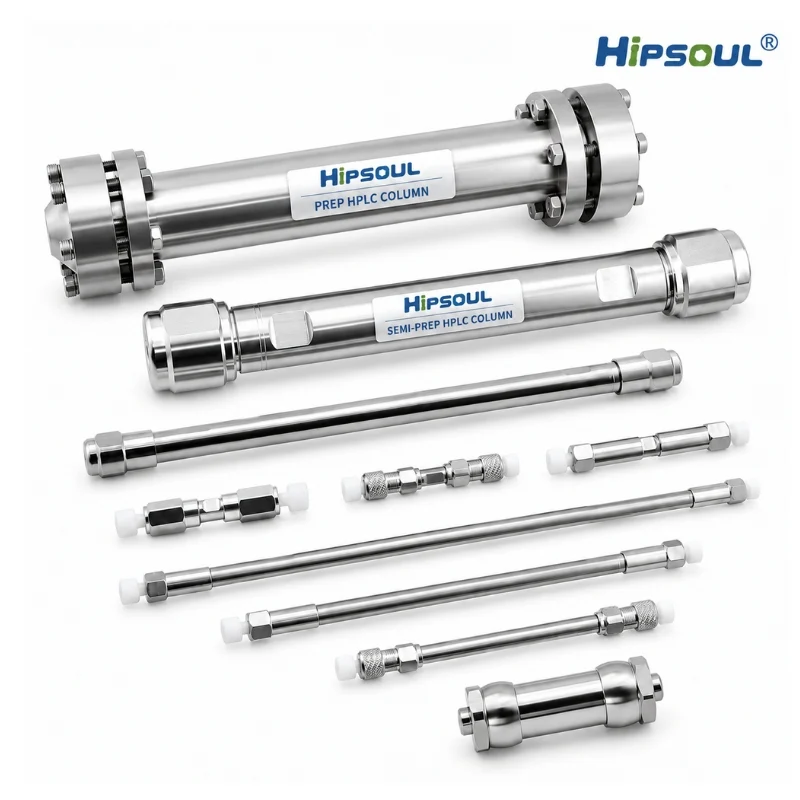
| Factor | Unit-mass MS/MS | High-resolution MS |
|---|---|---|
| What is recorded | A selected precursor, then a product ion | An accurate mass, and sometimes accurate-mass fragments |
| What it distinguishes | Targets that share a retention time but not a transition | Ions that share a nominal mass but not an accurate mass |
| Typical question | Is this the known target, and how much is present? | Which formulas are still possible? |
| Identification | Confirms a known target when the transition and the retention time agree | Narrows the formula. A full structure still needs more evidence. |
| What HIPSOUL publishes | Waters LC-MS/MS systems, and Agilent GC-MS systems | No resolving power and no high-resolution model name |
If a project needs an accurate mass, say that when you contact the laboratory. The team will state what the available data can support. Do not read a resolving power into the instrument names on the services page.
Published Routes Around High-Resolution MS
The column is the separation when the method is liquid chromatography. The mass spectrometer is the detector. HIPSOUL supplies the column side and will say which listed technique a project can use.
HPLC and UHPLC Columns
- HPLC columns and UHPLC columns
- The liquid separation in front of a mass spectrometer
- Phase, ID, and particle size still come from the sample
- The column does not set the resolving power
LC-MS/MS for a Transition
- Precursor and product ion for a known target
- Waters LC-MS/MS systems are on the laboratory list
- Nitrosamine and PFAS pages quantify this way
- Use this route when the formula is not the open question

GC-MS for a Volatile Sample
- The analyte has to travel in a carrier gas
- Agilent GC-MS systems are on the laboratory list
- FID and ECD remain the non-mass GC detectors
- HIPSOUL does not publish a GC column catalog

Ask What the Data Can Support
- Say if the open question is an accurate mass
- The published list does not name a high-resolution model
- LC-MS, GC-MS, UV-Vis, IR, and NMR are the named techniques
- The reply should state what the data can and cannot support
What Changes When the Question Is Accurate Mass
These choices decide whether high-resolution MS is the technique to ask for. They are not a formula assignment on every peak.
-
The Formula
Accurate mass removes some formulas that a unit mass would still allow. The remaining formula is not yet a structure.
-
Resolving Power
Resolving power belongs to the mass spectrometer. It is not a column dimension, a particle size, or a catalog row on the HPLC sheet.
-
A Transition Can Still Win
A known target at a trace limit is the LC-MS/MS question already described for nitrosamines and PFAS. Accurate mass is not a substitute for that method.
-
The Separation Still Has to Exist
Liquid samples use an HPLC or UHPLC column. Volatile samples use GC-MS. The mass analyzer does not replace that separation.
-
Say It Before the Project Starts
Write “accurate mass” in the request if that is the deliverable. Analytical services will match the request to a listed technique or say what cannot be supported.
When High-Resolution MS Is the Question
Start with the decision the data has to support. Then match a published route. Catalog columns live on the HPLC and UHPLC pages. Instrument resolving power does not.
-
A formula is still open
An accurate mass can reduce the formulas that fit a peak. Pair it with the retention time, and with another technique already named on the services page when the structure still has to be decided. Identification is not assumed in advance.
-
Two ions share a nominal mass
Unit-mass data can leave those ions unresolved. High-resolution MS is the measurement that separates them by accurate mass. Ask the laboratory whether that measurement is available before the project is scoped.
-
A known target at a trace limit
Stay on LC-MS/MS. The nitrosamine and PFAS pages describe tandem mass spectrometry for quantitation. A UV or PDA detector does not reach those limits, and an accurate-mass scan is not the method those pages name.
-
A volatile sample
Stay on GC-MS when the analyte has to travel in a carrier gas. Agilent GC-MS is the system the services page names for that work.
Typical Path for an Accurate-Mass Question
From the decision you need to the technique that can support it. HIPSOUL supplies the liquid-chromatography column. The mass spectrometer remains the instrument.
-
1 Write the Question
Formula, confirmation of a known target, or a measured amount. Those are three different requests.
-
2 Choose LC or GC
Liquid chromatography uses a published HPLC or UHPLC column. A volatile sample uses GC-MS. The sample decides.
-
3 Match the Mass Spectrometer
A transition, a unit-mass spectrum, or an accurate mass. The published instrument list states the first two families. It does not state resolving power.
-
4 Report the Limit of the Data
An accurate mass can narrow a formula. A structure, or a number at a regulatory limit, may still need the technique those other pages already name.
Where the Question Shows Up
Published HIPSOUL pages for the neighboring techniques. A card opens that page. High-resolution MS is the accurate-mass question. It is not silently added to every method below.



Tell Us Whether You Need an Accurate Mass
Send the analyte, the matrix, and whether a unit-mass transition is enough. Say if the deliverable is a formula rather than a quantity.
Contact Our ExpertsRelated Resources
Published HIPSOUL pages for the two mass-spectrometry routes already named, and for the laboratory that runs them. These are not customer case studies.
Related Technology
LC-MS/MS Technology
Read the Page
Related Technology
GC-MS Technology
Read the Page
Analytical Services
Laboratory Techniques and Instruments
View ServicesFrequently Asked Questions
High-resolution mass spectrometry measures mass accurately enough to distinguish ions that share a nominal mass. The result can narrow a molecular formula. It does not finish a structure by itself. HIPSOUL does not manufacture the mass spectrometer, and this page does not publish a resolving power.
LC-MS/MS, as described on that page, selects a precursor ion and a product ion. That transition confirms a known target and can quantify it. High-resolution MS separates ions by accurate mass, including ions that would look the same at unit mass. A transition can still be the better answer when the target is already known and the question is how much is present. This page does not publish a HIPSOUL detection limit for either technique.
The analytical services page lists Waters UPLC and LC-MS/MS systems, and Agilent GC and GC-MS systems. It does not state a resolving power and it does not name a high-resolution model. Those names are not treated on this page as a high-resolution mass spectrometer. If the project needs an accurate mass, say so when you contact the laboratory. The team will state what the available data can support.
When the separation is liquid chromatography, the column is an HPLC or UHPLC column from the published ranges, with the guard, filter, and fittings that match that flow path. A GC separation uses a GC column. HIPSOUL does not publish a GC column catalog. The mass spectrometer, at any resolving power, is the detector on the instrument.
When the target is known and the method needs confirmation or a trace measurement, the LC-MS/MS page is the route. Nitrosamine and PFAS quantitation on this site is described as LC-MS/MS. A volatile sample that needs a mass is a GC-MS question. Accurate mass is the question when ions that share a nominal mass still have to be distinguished, or when a formula is still open.
No. The column separates compounds in time. Resolving power is a property of the mass spectrometer. A different column can change the chromatogram. It does not add accurate-mass capability. Match the column to the liquid chromatograph. Confirm the mass spectrometer separately.