
Complex Matrix Analysis
Separate the target from the rest of the sample.
Cleanup and selectivity come before the number.
A complex matrix is the material around the analyte: particles, proteins, salts, co-extractives, or other peaks at the same retention time. This page covers the guards, filters, and column phases HIPSOUL supplies for that problem.

-
The Sample First
Food, environmental, and biological samples need cleanup before a stable chromatogram is realistic.
-
Guard or Filter
A filter stops particles. A guard column also holds a short bed of related packing.
-
Selectivity
Overlapping peaks are a separation question. C18 is only the common start.
-
Limit Is Separate
A dirty sample is not the same decision as a limit below the UV range.
-
Hardware or a Run
Buy the column and the guard, or ask analytical services to review the sample.
Complex Matrix Overview
The matrix is everything in the vial that is not the question you are asking. Water, soil, and waste samples are often dirty. Plasma and urine need cleanup before a stable chromatogram is realistic. Food and formulation samples carry co-extractives that can sit on top of the target.
The first hardware decision is protection and selectivity. An inline filter is for particles. A guard column adds a short bed of related packing so strongly retained material hits that bed before the analytical column. The phase of the analytical column then has to pull the target away from the peaks that remain. C18 is a common start. HILIC, phenyl, PFP, normal phase, and SEC are published for other chemistries.
The matrix does not choose the detector. If the analyte has a chromophore and the level is inside the UV or PDA range, absorbance can still be the result after the separation is clean. If the limit sits below that range, the method belongs on trace-level analysis. Analytical services can discuss preparation and column selection for a project. HIPSOUL does not manufacture a sample-preparation system for every matrix.
Open analytical services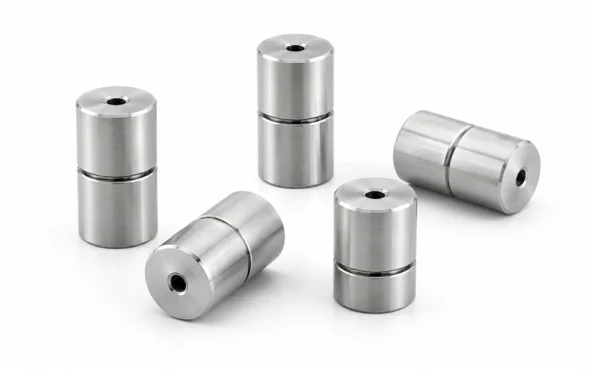
| Factor | Clean assay | Complex matrix |
|---|---|---|
| What is in the way | A few related peaks | Particles, proteins, salts, co-extractives, or a peak at the same time |
| First hardware | The analytical column | A guard column, an inline filter, or both, then the analytical column |
| The separation question | Target from related substances | Target from matrix peaks that share a retention time |
| The detector | UV, PDA, or MS, based on the limit | The same rule. The matrix does not replace that decision. |
| A low limit | Can already be trace-level analysis | Still a trace question if the limit is below the UV range |
| What HIPSOUL supplies | The column for the assay | Guards, filters, frits, and a phase chosen for the interference |
How far a result can go depends on the matrix, the amount of analyte, and the reference information available. This page does not publish a recovery or a detection limit.
Columns and Consumables for Complex Matrices
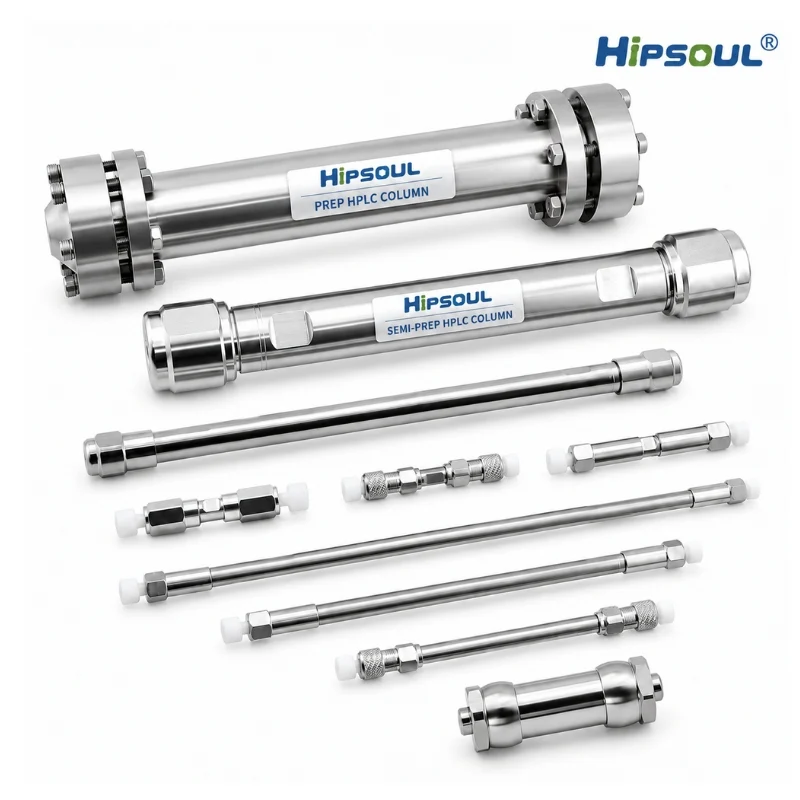
Hardware from the published HIPSOUL range. The guard and the filter meet the sample. The analytical column meets the interference that remains. A Ghost Buster Column meets the mobile phase, not the vial.
Guard Columns
- Sits after the injector, ahead of the analytical column
- A short bed of related packing catches strongly retained material
- 2.1 mm direct-connect hardware is published for UHPLC
- Match the phase to the analytical column
Inline Filters & Frits
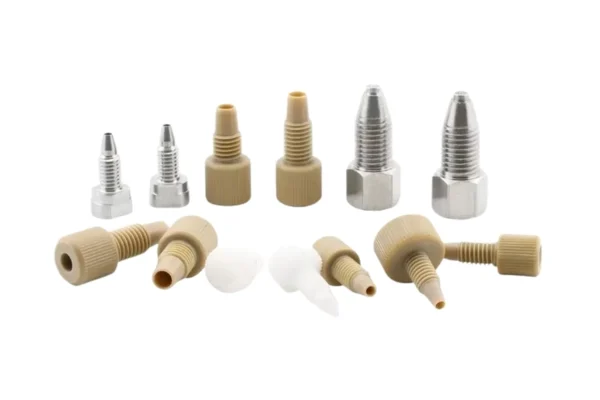
- Use an inline filter when particles are the risk
- Frits for the flow path
- Environmental extracts and other dirty samples are the usual case
- A filter does not change selectivity
Analytical Columns
- C18 is a common start for many small molecules
- Phenyl, PFP, and HILIC when C18 does not pull the peaks apart
- UHPLC columns when the system is rated for them
- Phase follows the analyte and the interference

Not the Sample: Ghost Buster
- Traps impurities from solvents and gradient mixing
- Installed upstream of the injector
- Aimed at ghost peaks that are not in the vial
- Does not replace a guard column
What Changes on a Complex-Matrix Method
These are the choices that decide whether the target can be measured in that sample. They are not a guaranteed recovery on every matrix.
-
Name the Matrix
Food, plasma, soil, a formulation, and a neat standard are different samples. Send the matrix with the analyte. The column phase cannot be chosen from the analyte name alone.
-
Protect the Column
Particles call for an inline filter. Strongly retained material calls for a guard with related packing. The applications page uses both so the analytical column keeps its peak shape.
-
Change Selectivity
Overlapping peaks are a reason to review the separation before a number is reported. A different phase, such as phenyl, PFP, or HILIC, is the published alternative when C18 does not separate the interference.
-
Keep the Limit Separate
Cleanup does not create sensitivity. A limit below the UV range still belongs on trace-level analysis, even after the matrix is under control.
-
Outside the Sheet
Other dimensions and phases can be discussed from the OEM page. Share the matrix and the current chromatogram before a format is confirmed.
When Complex Matrix Analysis Is the Method
Start with what is interfering, then match a published guard, filter, or column. Catalog numbers live on the product pages linked above.
-
A dirty environmental sample
The environmental page describes water, soil, and waste as often dirty. HPLC or UHPLC provides the separation. Guard columns and inline filters protect the analytical column from particulates. A regulatory trace limit in that matrix is still LC-MS/MS.
-
Plasma, urine, or another biological matrix
The clinical research page says these matrices need cleanup before a stable chromatogram is realistic. A drug check can stay on HPLC when the detector fits the concentration. Trace toxicology in the same matrices is typically LC-MS/MS.
-
Food, beverage, or a formulation
The food page covers sugars, vitamins, organic acids, additives, and some residues. A UV method can quantify many additives. Residues are usually confirmed by LC-MS/MS. The co-extractives are the matrix problem. The limit is a separate problem.
-
Overlapping peaks
Review the separation goal and the column phase before a quantitative conclusion is drawn. A Ghost Buster Column is the tool when the extra peak comes from the mobile phase, not from the sample.
Typical Complex-Matrix Workflow
From a named sample to a chromatogram the integrator can trust. HIPSOUL supports the column and consumable steps. Project work is discussed under analytical services.
-
1 Name the Sample
State the matrix, the target, and the decision the result has to support. A chromatogram of the current method shows which peak is in the way.
-
2 Protect the Flow Path
Filter particles. Add a guard when strongly retained material is the risk. Leave Ghost Buster Columns for mobile-phase peaks.
-
3 Separate the Interference
Choose a phase that moves the target away from the matrix peak. Optimize that separation before the quantitative conclusion.
-
4 Detect at the Real Limit
Use UV or PDA when that range covers the level. Move to LC-MS/MS when the limit, or the published method, requires a transition.
Where Complex Matrix Analysis Is Used
Uses already described on published HIPSOUL pages. Each card opens that page. See the full set on Applications.



Need a Column for a Difficult Matrix?
Send the matrix, the target, the current column if you have one, and a chromatogram if the interference is already visible. Say whether you need hardware or a sample review.
Contact Our ExpertsRelated Resources
Published HIPSOUL pages for the guard, the trace-level limit, and the laboratory. These are not customer case studies.
Column Range
HPLC Guard Columns
View Catalog
Related Technology
Trace-Level Analysis
Read the Page
Analytical Services
Sample and Method Review
View ServicesFrequently Asked Questions
Complex matrix analysis is the work of separating a target from the rest of a dirty sample: particles, proteins, salts, co-extractives, or other peaks that share a retention time. HIPSOUL supplies the guard columns, inline filters, frits, and analytical columns for that flow path. The matrix does not, by itself, choose the detector.
A complex matrix is what else is in the sample. A trace-level limit is how little of the target the result has to see. A dirty sample at an assay level can stay on UV or PDA after cleanup, when the chromophore and the detector range already cover the limit. A limit below that range is trace-level analysis, usually LC-MS/MS on this site.
Use an inline filter when particles are the risk. Use a guard column when you also need a short bed of related packing to catch strongly retained material before it reaches the analytical column. A Ghost Buster Column is a different part. It sits before the injector and traps mobile-phase impurities. It does not clean the sample.
Start with the analyte polarity and the interference, not with a longer column of the same phase. C18 is a common start for many small molecules. HILIC, normal phase, phenyl, PFP, and SEC are published for other chemistries. Overlapping peaks are a reason to review the separation before a quantitative conclusion is drawn.
No. HIPSOUL manufactures chromatography columns and consumables. Analytical services can discuss sample preparation, column selection, and mobile-phase conditions for a project. Acceptance depends on the matrix, the analytical question, and whether a suitable method is feasible.
Yes, when the project fits the techniques already listed. Typical samples include formulations, food and beverage matrices, and environmental samples. Tell us the matrix, the target, and the decision you need. If a sample sits outside those techniques, the laboratory will say so before the project starts.