
LC-MS/MS Technology
Confirm the transition, not only the peak.
The column separates. The mass spectrometer confirms.
LC-MS/MS pairs a liquid-chromatography separation with tandem mass spectrometry. This page covers when a precursor-and-product-ion result is the right choice, and the columns, guards, and fittings HIPSOUL supplies for that flow path.

-
Two Stages
The column sets the retention time. MS/MS selects a precursor and a product ion.
-
A Transition
The recorded result is a precursor ion and the product ion that follows it.
-
Trace Confirmation
Nitrosamine and PFAS pages on this site quantify by LC-MS/MS.
-
Column ID
The guard page pairs 2.1 mm hardware with UHPLC / LC-MS.
-
Hardware or a Run
Buy the column, or ask analytical services to run LC-MS/MS.
LC-MS/MS Overview
LC-MS/MS uses the same packed-column separation as HPLC and UHPLC. A liquid mobile phase carries the sample through the column, and compounds leave at different times. The detector is a tandem mass spectrometer. It selects one ion from that peak, fragments it, and records a product ion.
Single-stage LC-MS stops at the mass-to-charge value. LC-MS/MS adds the product ion, so the method can ask a more selective question: is this the target, and how much is present? A UV or PDA chromatogram answers a different question. It records absorbance. Naming an unknown, or measuring below the UV working range, moves the same separation onto a mass spectrometer.
HIPSOUL manufactures the HPLC columns, UHPLC / UPLC columns, guard columns, and fittings on that flow path. The analytical services laboratory lists Waters UPLC and LC-MS/MS systems for project work. HIPSOUL does not manufacture the mass spectrometer.
Open analytical services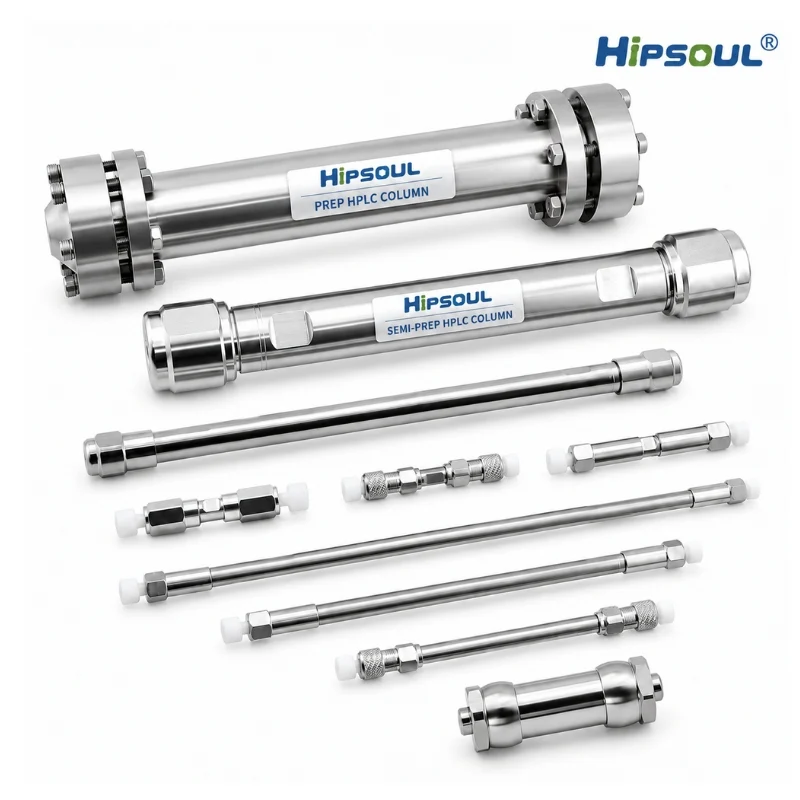
| Factor | LC-MS | LC-MS/MS |
|---|---|---|
| What is recorded | Mass-to-charge of ions from the source | A selected precursor ion, then a product ion |
| Selectivity | Retention time plus a mass | Retention time plus a transition |
| Typical question | What mass is in this peak? | Is this the target, and how much is present? |
| Identification | Supports an identification. A full structure still needs more evidence. | Confirms a known target when the transition and the retention time agree. A full structure still needs more evidence. |
| Mobile phase | Has to be volatile. Non-volatile salts are a poor match for the ion source. | The same constraint. The source has to accept the solvents and the additives. |
| What HIPSOUL supplies | Columns, guards, filters, and fittings. Analytical services can include LC-MS. | The same hardware. Analytical services list Waters LC-MS/MS systems. |
Sensitivity, the transition, and whether a peak can be named depend on the instrument, the matrix, the amount of analyte, and the reference information available. This page does not publish a detection limit.
Columns and Consumables for LC-MS/MS
Hardware from the published HIPSOUL range. The column does the separation. The guard, filter, frit, and fitting keep the flow path short and clean. The mass spectrometer is the detector on the instrument.
HPLC & UHPLC Columns
- HPLC columns and UHPLC / UPLC columns
- 2.1 mm, 3.0 mm, and 4.6 mm on the UHPLC sheet
- 1.7 µm is the 1.0×50 mm and 1.0×100 mm pair
- Phase still comes from the analyte
HILIC Columns
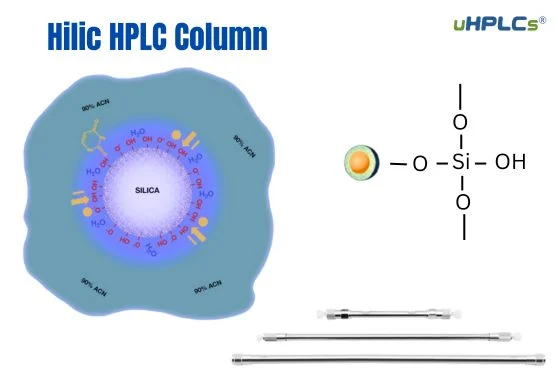
- USHD HILIC-SiO2, HILIC-Amide, and HILIC-ZIL
- Polar compounds that are poorly retained on C18
- The HILIC page describes them for LC-MS and LC-MS/MS
- High-organic mobile phase, as published on that page
Guard Columns
- 2.1×4.0 mm direct-connect for UHPLC / LC-MS
- Holder P3K0B-00272 on the guard-column page
- C18, C8, Phenyl, and HILIC cartridges in that row
- Keeps extra-column volume small
Fittings, Tubing & Filters
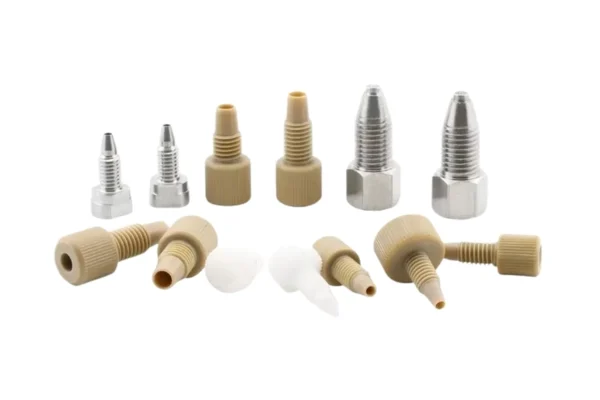
- PEEK and stainless steel fittings
- Capillary tubing
- Inline filters and frits for particles
- Match thread, bore, and the flow the method runs
What Changes on an LC-MS/MS Method
These are the choices that decide whether the separation can be confirmed. They are not a guaranteed detection limit on every sample.
-
The Transition
Selectivity comes from the precursor ion and the product ion, together with the retention time. A wavelength does not answer that question.
-
A Volatile Mobile Phase
The ion source has to accept the solvents and the additives. Non-volatile salts are a common reason an existing LC method will not transfer.
-
Internal Diameter
The UHPLC sheet lists 2.1 mm, 3.0 mm, and 4.6 mm, plus 1.0 mm at 1.7 µm. Match the ID to the flow the pump and the source can run.
-
A Short Flow Path
The guard page points 2.1 mm direct-connect hardware at UHPLC / LC-MS where extra-column volume has to stay small. Tubing and fittings have to match that bore.
-
Outside the Sheet
Other dimensions, phases, and end fittings can be discussed from the OEM page. Share the LC-MS system before a format is confirmed.
When LC-MS/MS Is the Method
Start with the question the result has to answer. Then match a published column or an analytical-service request. Catalog numbers live on the column pages linked above.
-
A known target at a trace limit
The nitrosamine and PFAS pages describe quantitation by LC-MS/MS. The separation can sit on an HPLC or UHPLC column. A UV or PDA detector does not reach those limits.
-
An unknown peak
Analytical services can investigate an unexpected peak by separation and, where the project needs it, mass spectrometry. Identification is not assumed in advance. The amount of impurity and the matrix decide how far the data can go.
-
A polar analyte
The HILIC column page describes USHD HILIC-SiO2, HILIC-Amide, and HILIC-ZIL for compounds that are poorly retained on C18, and it points those columns at LC-MS and LC-MS/MS.
-
A UV method that already works
Stay on HPLC and UHPLC when the analyte has a chromophore and the detector range covers the limit. Moving that assay to LC-MS/MS is a different method, with a volatile mobile phase and a tandem mass spectrometer.
Typical LC-MS/MS Workflow
From a sample the column can accept to a result the data can support. HIPSOUL supports the column and consumable steps. Project work is discussed under analytical services.
-
1 Prepare the Sample
Filter, dilute, or extract so the column and the ion source see a solution the method can handle.
-
2 Separate
Choose the phase, the internal diameter, and a volatile mobile phase. Match fittings and tubing to that flow.
-
3 Select the Transition
The mass spectrometer selects the precursor and the product ion. HIPSOUL does not manufacture that detector.
-
4 Report What the Data Supports
A transition and a retention time can confirm a known target. A full structure, or a peak with too little material, may still need more evidence.
Where LC-MS/MS Is Used
Uses already described on published HIPSOUL pages. Each card opens that page. The column is the separation step. See the full set on Applications.





Need a Column for an LC-MS/MS Method?
Send the analyte, the matrix, the LC-MS system, and the column dimensions if a method already exists. Say whether you need hardware or a sample run.
Contact Our ExpertsRelated Resources
Published HIPSOUL pages for the service, the polar-column range, and the chromatography technique. These are not customer case studies.
Analytical Services
LC-MS/MS Project Work
View Services
Column Range
HILIC Columns for Polar Analytes
View Catalog
Related Technology
HPLC & UHPLC Technology
Read the PageFrequently Asked Questions
LC-MS/MS is liquid chromatography followed by tandem mass spectrometry. The column separates compounds in time. The mass spectrometer then selects a precursor ion from that peak and records a product ion. HIPSOUL supplies the columns and consumables for the chromatography step. HIPSOUL does not manufacture the mass spectrometer.
LC-MS records a mass-to-charge value from the ion source. LC-MS/MS selects a precursor ion and then a product ion, so the result is a transition as well as a retention time. A transition is the usual choice when the matrix, or the limit the method has to reach, makes a single mass insufficient. This page does not publish a HIPSOUL detection limit for either technique.
No. HIPSOUL manufactures chromatography columns and consumables. The analytical services page lists Waters UPLC and LC-MS/MS systems as instruments the laboratory uses. Those systems are not HIPSOUL products.
Start with the analyte, the matrix, and the flow the ion source can accept. The UHPLC column sheet includes 2.1 mm, 3.0 mm, and 4.6 mm internal diameters. 1.7 µm on that sheet is the 1.0×50 mm and 1.0×100 mm pair. The guard-column page pairs 2.1 mm direct-connect hardware with UHPLC / LC-MS. HILIC columns are published for polar compounds and for LC-MS and LC-MS/MS. Match the phase, particle size, and pressure rating to the system. The catalog row is the specification.
Changing the column changes the separation. LC-MS/MS still requires a tandem mass spectrometer on the instrument, and a mobile phase the ion source can accept. The nitrosamine and PFAS pages on this site describe quantitation by LC-MS/MS because a UV or PDA detector does not reach those limits. A guard column or an inline filter protects the flow path. It does not add the detector.
Yes, when the project needs it. The analytical services page lists Waters UPLC and LC-MS/MS systems, and it describes identification work that can include LC-MS. How far an identification can go depends on the amount of impurity, the matrix, and the reference information you can share. Buying a column and sending a sample for analysis are different requests.