
HPLC & UHPLC Technology
Reliable Separation. Accurate Analysis.
From Analytical to Preparative.
Explore high-performance liquid chromatography technologies, separation workflows, detection approaches, and compatible chromatography solutions for diverse analytical applications.
-
High Resolution
Narrower peaks when particle size and system volume are matched.
-
Separation Flexibility
Analytical through preparative column formats in the published range.
-
Method Support
Method development guidance and published application routes.
-
Reliable Performance
Guards, filters, and fittings that keep a flow path stable.
-
Application Expertise
Industry pages for pharma, food, environment, and related work.
HPLC & UHPLC Overview
HPLC (high-performance liquid chromatography) and UHPLC (ultra-high-performance liquid chromatography) separate compounds as a liquid mobile phase carries the sample through a packed column. Phase chemistry, particle size, column dimensions, and the mobile phase decide which compounds leave the column at different times.
Laboratories use both techniques for pharmaceutical, biopharmaceutical, food, environmental, and chemical analysis, from routine assays to preparative isolation. HIPSOUL supplies HPLC columns, UHPLC / UPLC columns, guard columns, inline filters, and related consumables for these workflows. HIPSOUL does not manufacture the complete instrument.
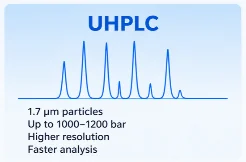
UHPLC uses the same separation principle as HPLC. It is typically run with smaller particles and with hardware rated for higher pressure. A method still has to be checked after transfer. Extra-column volume, detector settings, and sample solubility can remove the expected gain.
Read the HPLC vs UHPLC article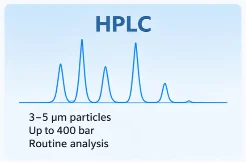
| Factor | HPLC | UHPLC |
|---|---|---|
| Particle size | Often 3-5 µm | Often below 2 µm, including about 1.7 µm |
| Operating pressure | Conventional systems are often rated near 400 bar | Systems are often rated from about 600 to 1500 bar |
| Analysis speed | Run time follows column length, flow, and the method | Shorter runs are possible when pressure and extra-column volume allow it |
| Resolution | Suitable for many routine separations | Can improve peak capacity when particle size and system volume match |
| System compatibility | Columns and fittings rated for that HPLC system | Needs a column, fittings, and tubing rated for the higher pressure |
Actual pressure, speed, and resolution depend on the instrument, the column, the fittings, and the method conditions.
Complete HPLC & UHPLC Solutions
Columns and consumables from the published HIPSOUL range. Photographs show the hardware as supplied.
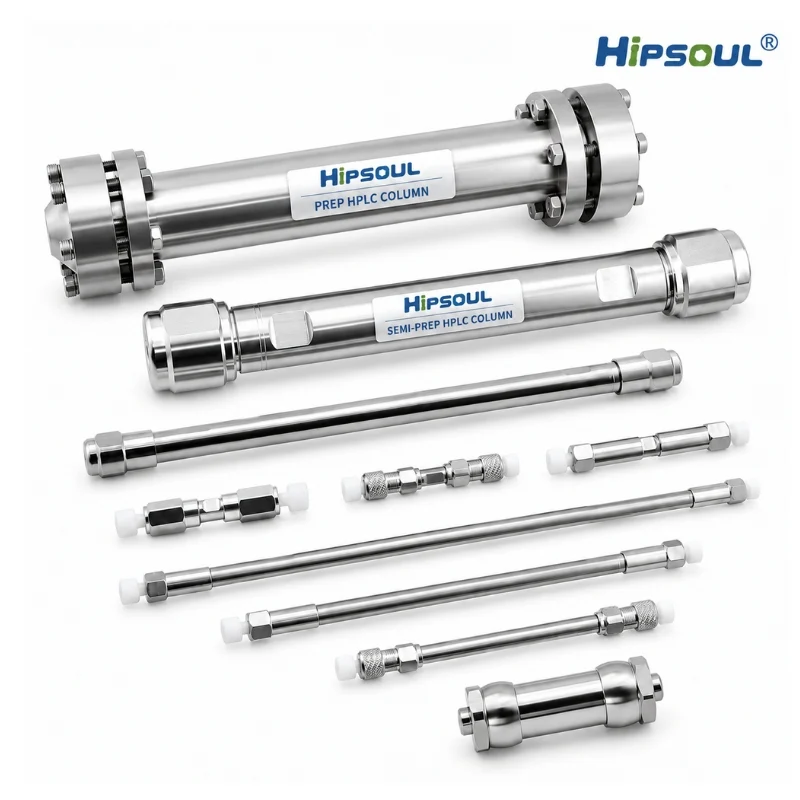
HPLC/UHPLC Columns
- Analytical columns
- UHPLC / UPLC columns
- Preparative columns
- Phase chemistry matched to the sample
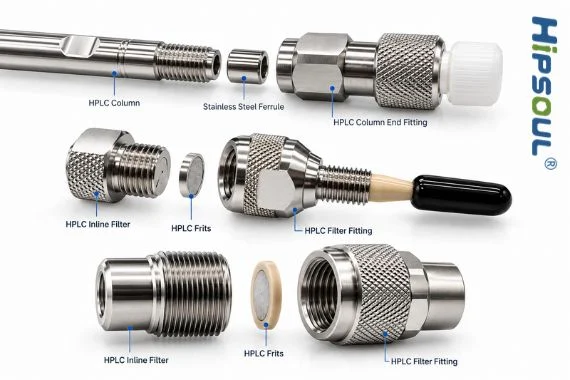
In-Line Filters & Frits
- Inline filter holders
- Replaceable frits
- Stainless steel and PEEK options
- Particle protection, not a chemical separation
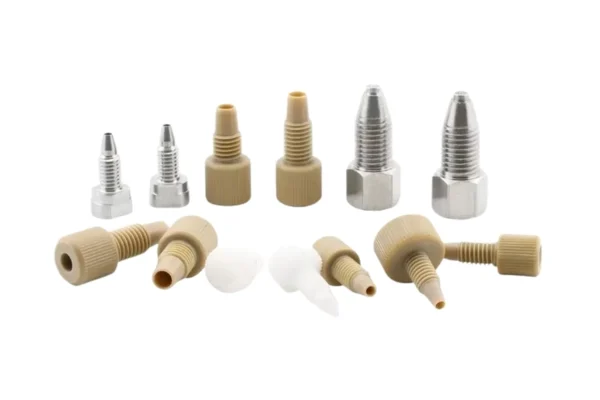
Fittings, Tubing & Accessories
- PEEK and stainless steel fittings
- Capillary tubing
- Sample loops
- Match thread, bore, and pressure rating
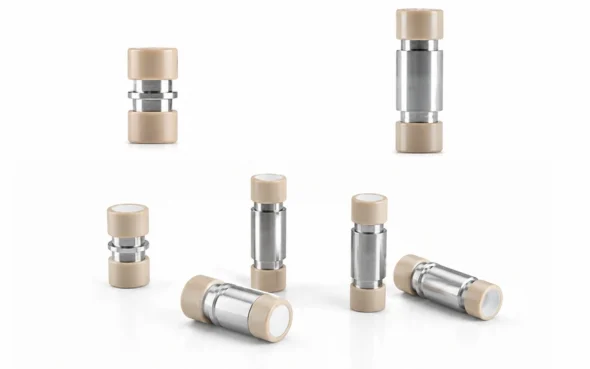
Guard Column Solutions
- Cartridge and holder formats
- Analytical and preparative sizes
- Direct-connect options in the published range
- Protects the analytical column from sample material
Key Technical Advantages
What changes in the separation, and which HIPSOUL products support that step. These are technical characteristics, not a guaranteed result on every method.
-
High Resolution
Smaller particles and a short, well-matched flow path can narrow peaks. Selectivity still comes from the phase and the mobile phase.
-
Faster Analysis
Shorter columns and higher linear velocity can reduce run time when the system pressure rating allows the method.
-
Wide Selectivity
Reversed-phase, HILIC, normal-phase, and other chemistries are published as separate column families. The sample chooses the phase.
-
Reliable Performance
A guard column, inline filter, frit, and the correct fitting reduce avoidable pressure rise and contamination. They do not replace method robustness work.
-
Custom Solutions
OEM and custom column hardware can be discussed from the OEM page. Share dimensions, chemistry, and pressure before a format is confirmed.
Applications
HPLC and UHPLC are used across these published application areas. Each card opens the existing HIPSOUL page for that industry. See all routes on Applications.
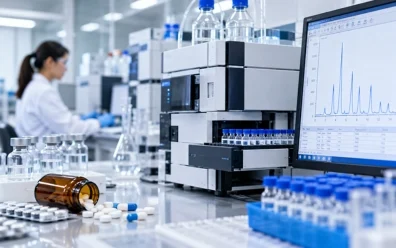
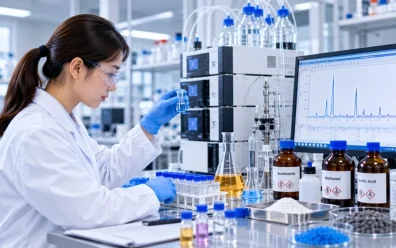
Typical Workflow
From sample preparation to the result. HIPSOUL supports the column and consumable steps, and analytical services when method development or testing is the actual need.
-
1 Sample Preparation
Filter, dilute, or extract the sample so the column sees a solution the method can handle.
-
2 Chromatographic Separation
The column, mobile phase, and flow path separate the compounds. Match particle size and pressure rating to the instrument.
-
3 Detection
UV/PDA, ELSD, CAD, or MS, depending on the analyte and on the detector installed on the system.
-
4 Data Analysis
Integrate the chromatogram and decide what the result supports. A question the detector cannot answer needs a different technique.
Detection Options for HPLC & UHPLC
The detector has to match the analyte and the mobile phase, and it has to be present on the instrument. HIPSOUL supplies columns and consumables used with these detectors. HIPSOUL does not manufacture UV, PDA, ELSD, CAD, or mass-spectrometry detectors. This section is a selection note, not a full LC-MS/MS method guide.
-
UV / PDA
The usual first detector when the analyte has a chromophore. PDA adds a spectrum, which helps check peak purity. It does not identify an unknown the way mass spectrometry can.
-
ELSD
Used for analytes with weak or no UV response, such as some lipids and sugars, when the mobile phase can be volatilized. Response is not linear across every range. Confirm the fit before using it for assay.
-
CAD
Another aerosol detector for weak-UV analytes. It can be more uniform than ELSD for some compound classes, and it still depends on a volatile mobile phase and on the detector actually installed.
-
Mass spectrometry
Used when the method needs identification or a lower detection level than UV can support. Column chemistry, dimensions, and flow have to suit the ion source. Method development for that work is covered under analytical services.
Need Help Choosing the Right HPLC/UHPLC Solution?
Explore suitable columns, consumables, separation methods, and analytical support for your application.
Contact Our ExpertsRelated Resources
Guides already published on uhplcs.com. These are technical articles, not customer case studies.

Method Guide
HPLC Method Development Guide
Read Now
Technical Article
HPLC vs UHPLC: Key Differences and How to Choose
Read Now
Product Guide
A Complete Guide to Guard Columns
Read NowFrequently Asked Questions
HPLC and UHPLC use the same liquid chromatography principle. A liquid mobile phase carries the sample through a packed column, and compounds leave the column at different times. UHPLC typically uses smaller particles and a system, column, and fittings rated for higher pressure. That can shorten a run or improve resolution when the method is transferred carefully. The particle-size and pressure figures on this page are typical instrument-class ranges, not HIPSOUL test results.
Start with the analyte, the sample matrix, the detector, and the pressure limit of the instrument. Then choose phase chemistry, particle size, and column dimensions. HIPSOUL publishes an HPLC column range and a separate UHPLC / UPLC column range. Preparative columns are a different choice when the goal is isolation rather than a routine assay.
UV and PDA detectors are common when the analyte has a useful chromophore. ELSD and CAD are used for analytes with weak UV response, when the mobile phase is compatible. Mass spectrometry is used when the method needs identification or a lower detection level than UV can support. The detector has to be installed on the instrument. HIPSOUL supplies columns and consumables used with these detectors and does not manufacture the detectors.
Only when the column pressure rating, fittings, and internal diameter are suitable for that system. A conventional HPLC column is not automatically safe on a high-pressure UHPLC method. A sub-2 µm UHPLC column is also a poor match for a conventional HPLC system if the pressure rating or extra-column volume is wrong. Check the published column range and the instrument limit before transferring a method.
Resolution depends on selectivity, retention, and peak width. Practical factors include phase chemistry, particle size, column length, mobile phase, temperature, flow rate, sample load, and extra-column volume in the tubing, fittings, and detector. No single HIPSOUL specification sets the resolution of a method.
HIPSOUL manufactures chromatography columns and consumables and discusses OEM or custom hardware on the OEM page. Share the dimensions, chemistry, pressure requirement, and quantity. This page does not confirm every custom format. The technical team has to review the specification.