In HPLC, most performance problems don’t start at the detector — they start before the column.
High back pressure, rising baseline noise, poor peak shape, and unexpectedly short column lifetime are often blamed on the analytical column itself. But in many cases, the real issue is insufficient protection upstream.
That’s where guard columns and in-line filters come in.
They’re both designed to protect your HPLC system and analytical column, but they work in very different ways. Choosing the wrong one — or assuming they’re interchangeable — can quietly cost you time, money, and data quality.
So which one should you use?
Let’s break it down.

1. What Is a Guard Column?
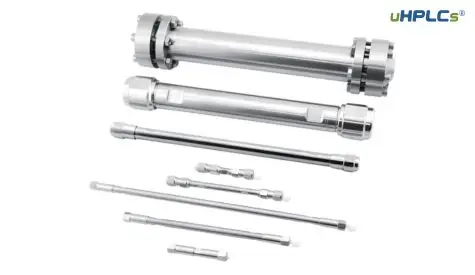
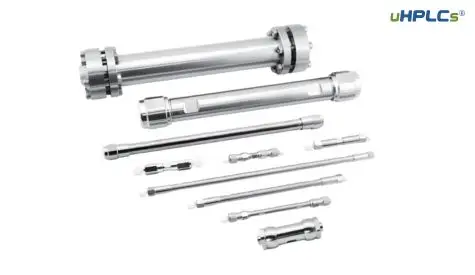
A guard column is essentially a short sacrificial column packed with the same or similar stationary phase as your analytical column. It is installed between the injector and the analytical column.
How a guard column works
- Traps particulate matter
- Retains strongly retained chemical contaminants
- Mimics the separation environment of the main column
- Protects the analytical column’s inlet frit and stationary phase
Because it contains packing material, a guard column behaves like a mini chromatography column — just much shorter.
Typical characteristics
- Packed with C18, C8, phenyl, HILIC, etc.
- Length: usually 5–10 mm
- Inner diameter matched to the analytical column
- Replaceable cartridge or disposable format
Think of a guard column as a bodyguard that takes the damage first.

2. What Is an In-Line Filter?
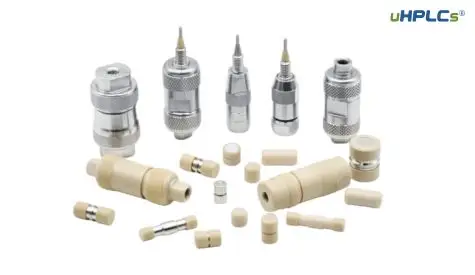
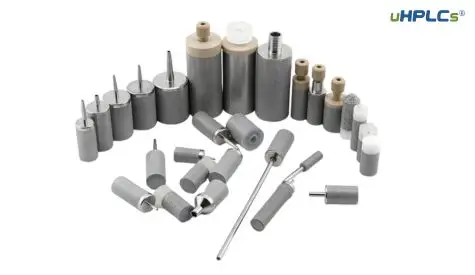
An in-line filter is a purely mechanical filtration device installed in the flow path — typically before the column or between system components.
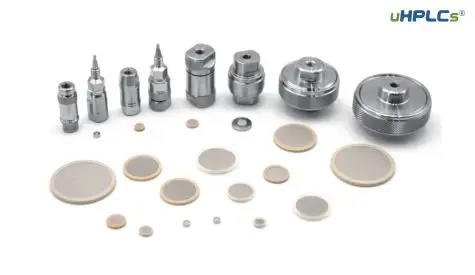
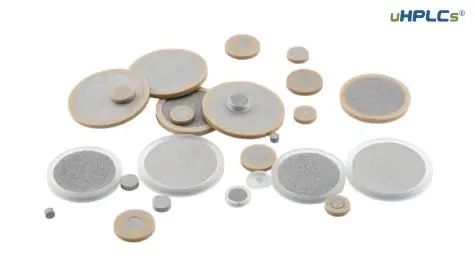
Unlike a guard column, an in-line filter contains no stationary phase. Instead, it uses a microporous filter element (often stainless steel or polymer) to physically block particles.
How an in-line filter works
- Physically intercepts particles
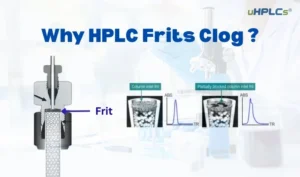
- Prevents particulates from reaching the column frit
- Does not interact chemically with analytes
- Does not contribute to retention or separation
Typical characteristics
- Pore sizes: 0.2 μm, 2 μm, 5 μm
- Extremely low dead volume
- Minimal impact on retention time
- Long service life if cleaned properly
An in-line filter is more like a security checkpoint — simple, effective, and invisible when working properly.
3. Key Differences at a Glance
| Aspect | Guard Column | In-Line Filter |
| Function | Chemical + physical protection | Physical particle protection |
| Contains stationary phase | Yes | No |
| Affects retention | Slightly | No |
| Dead volume | Higher | Extremely low |
| Back pressure | Adds noticeable pressure | Minimal |
| Protects against chemical fouling | Yes | No |
| Cost per replacement | Higher | Lower |
| Method compatibility | Must match column chemistry | Universal |
This table already hints at an important truth:
They solve different problems.
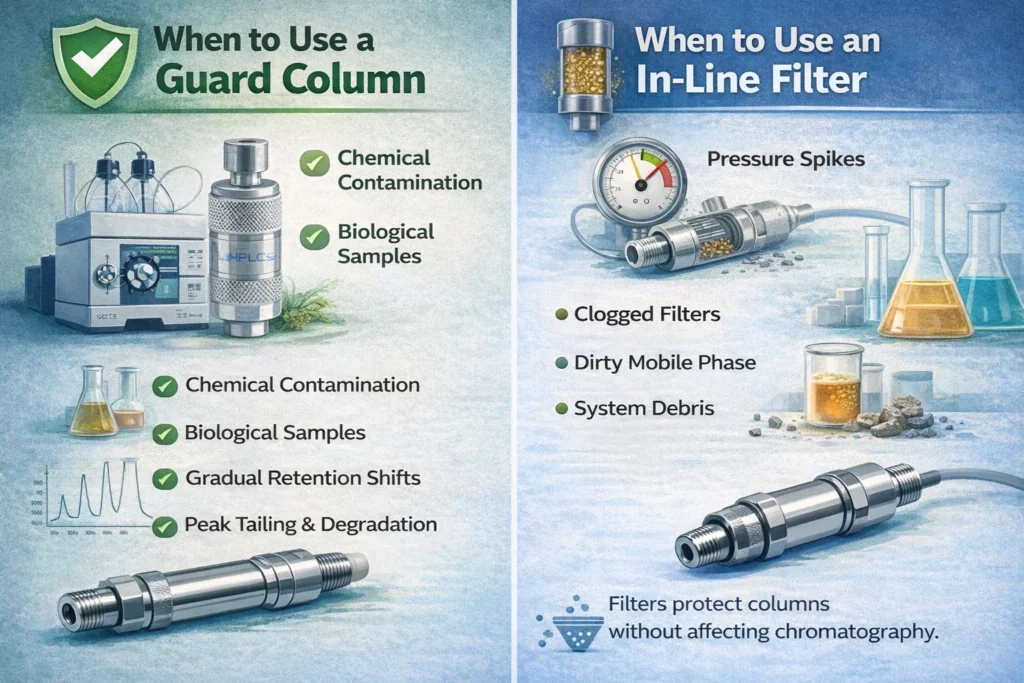
4. What Problems Does a Guard Column Solve Best?
A guard column is most effective when chemical contamination is a major concern.
Use a guard column if:
- Your samples contain strongly retained compounds
- You work with biological matrices (proteins, lipids)
- You see gradual retention time shifts
- Peak tailing worsens over time
- Column performance degrades chemically, not suddenly
Typical scenarios
- Pharmaceutical impurity analysis
- Bioanalysis (plasma, serum, tissue extracts)
- Natural products and complex formulations
- Environmental samples with organic contaminants
In these cases, particles aren’t the main enemy — chemistry is.
5. What Problems Does an In-Line Filter Solve Best?
In-line filters shine when the problem is physical contamination, not chemistry.
Use an in-line filter if:
- You experience sudden pressure spikes
- Columns clog without warning
- Your mobile phase isn’t perfectly clean
- Gasket fragments or pump debris appear
- You want protection without changing retention
Typical scenarios
- Routine QC analysis
- High-throughput labs
- Gradient methods sensitive to extra volume
- Systems with frequent solvent switching
- RID or baseline-sensitive applications
In-line filters protect columns without interfering with chromatographic behavior.
6. Back Pressure: The Silent Decision-Maker
Back pressure often decides whether a guard column or an in-line filter is the better choice.
Guard columns and pressure
- Add measurable system back pressure
- Pressure increases as the guard becomes fouled
- Can mask early signs of column clogging
In-line filters and pressure
- Very low initial pressure drop
- Pressure rise is sudden and obvious
- Easier to diagnose and replace
If your system already operates near its pressure limit, adding a guard column may push it into unsafe territory.
7. Baseline Stability and Solvent Effects
This is where many people make a mistake.
Guard columns introduce:
- Extra dead volume
- Additional mixing zones
- Slight solvent interaction effects
In gradient elution, RID detection, or low-level impurity analysis, this can lead to:
- Baseline drift
- Increased noise
- Reduced signal-to-noise ratio
- In-line filters, by contrast:
- Have negligible dead volume
- Do not alter solvent composition
- Preserve baseline stability
If your priority is clean baseline and reproducibility, an in-line filter is often the safer choice.
8. Cost and Maintenance Considerations
Guard columns
- Higher upfront cost
- Chemistry-specific inventory
- Regular replacement required
- Incorrect choice can damage results
In-line filters
- Lower cost per unit
- Universal compatibility
- Cleanable and reusable options available
- Simple maintenance
For many labs, especially QC environments, in-line filters provide a better cost-to-benefit ratio.
9. Should You Use Both?
Yes — sometimes.
Using both a pre-column in-line filter and a guard column can provide layered protection in:
- Extremely dirty samples
- High-value analytical columns
- Critical long-term methods
However, stacking protection also stacks:
- Dead volume
- Back pressure
- Troubleshooting complexity
More protection is not always better — smarter protection is.
10. How to Choose: A Practical Decision Guide
Ask yourself these questions:
- Is my main issue particles or chemistry?
- Am I pressure-limited?
- Is my method sensitive to extra dead volume?
- Do I need universal compatibility?
- How often do I want to replace consumables?
Quick rule of thumb
- Particles only? → In-line filter
- Chemical fouling? → Guard column
- Baseline-sensitive method? → In-line filter
- Complex matrix? → Guard column (or both)
Final Thoughts
Guard columns and in-line filters are not competitors — they’re tools for different jobs.
The mistake isn’t choosing the wrong one.
The mistake is assuming one solution fits every HPLC problem.
By understanding what each device actually protects against, you can:
- Extend column lifetime
- Reduce downtime
- Maintain stable baselines
- Improve overall data quality
And sometimes, the simplest hardware change makes the biggest difference.
Conclusion
If column clogging, rising back pressure, or baseline instability are recurring challenges in your HPLC system, upstream protection is often the most practical place to start.
At uHPLCs, we offer high-performance in-line filters and chromatography protection solutions designed to intercept particulate contamination before it reaches critical system components — without introducing unnecessary dead volume or disrupting method reproducibility.
Our solutions are developed for routine analysis, gradient methods, and baseline-sensitive applications where system stability truly matters.
Visit www.uHPLCs.com to explore our HPLC protection solutions or contact our team to discuss your application needs.