Introduction
In High-Performance Liquid Chromatography (HPLC), the baseline represents the stability and reliability of your chromatographic system. A smooth and steady baseline ensures that peaks can be clearly identified and quantified with confidence. However, many analysts have faced the frustrating situation where the baseline shows irregular fluctuations, commonly referred to as baseline noise.
So why does baseline noise occur, and what can be done to minimize it? Understanding the causes of noise is the first step toward improving HPLC performance and ensuring accurate results. This article explores the nature of baseline noise, its impact, and effective strategies for reducing it.
What is Baseline Noise?
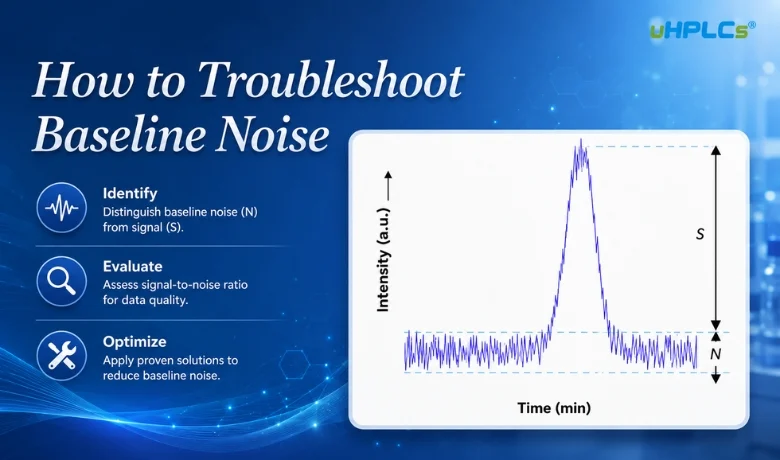
Baseline noise refers to the short-term, irregular fluctuations in the chromatographic baseline that are unrelated to actual analyte peaks. These fluctuations may appear as small, random up-and-down movements on the chromatogram.
It is important to distinguish baseline noise from baseline drift:
Baseline noise is rapid, random, and short-term, usually caused by detector or mobile phase instability.
Baseline drift is a gradual, long-term shift of the baseline, often due to temperature changes, mobile phase composition variation, or system instability.
Another critical factor linked to baseline noise is the signal-to-noise ratio (S/N). In chromatography, a higher S/N ratio means that analyte peaks are more easily detected above the noise level, leading to greater sensitivity and reliability. Excessive baseline noise lowers the S/N ratio, making it difficult to distinguish small peaks from background fluctuations.
Common Causes of Baseline Noise
Baseline noise in HPLC originates from various components of the system, and identifying the specific source is crucial for troubleshooting. The most frequent causes include:
Mobile Phase Issues
The mobile phase is one of the primary contributors to noise. Impurities in solvents can produce spurious signals, while dissolved gases may form microbubbles that scatter light in UV detectors. Poor solvent degassing or inadequate filtration also leads to unstable baselines. Even slight changes in mobile phase composition can alter refractive index or UV absorbance, increasing baseline variability.
Detector-Related Noise
Since the detector is responsible for capturing the analytical signal, any instability here is directly reflected in the baseline. Noise may arise from fluctuations in the light source intensity (e.g., deuterium lamp instability), photodiode dark current, or thermal and electronic noise in the detector circuitry. Choosing inappropriate wavelength or bandwidth settings can also exaggerate baseline fluctuations.
Column Problems
A deteriorated column can be a hidden source of noise. Loss of stationary phase particles, void formation, or column contamination by strongly retained compounds may cause irregular signal responses. Inconsistent packing within the column may also generate unstable pressure, indirectly impacting detector performance.
Pump and System Factors
Inconsistencies in pump performance often lead to baseline irregularities. Flow rate pulsation from poorly maintained pumps, worn seals, or check valve malfunctions can introduce rhythmic baseline noise. In gradient elution, delayed mixing or proportioning valve problems may cause transient composition changes, which appear as noise.
Environmental Influences
External conditions can also disturb the baseline. Temperature fluctuations near the detector cell alter solvent refractive index and viscosity, generating noise. Similarly, laboratory electrical interference (e.g., from nearby instruments, motors, or fluorescent lights) can introduce electronic spikes into the detector signal.
How Baseline Noise Affects Analysis
Baseline noise is more than a cosmetic issue on the chromatogram — it directly impacts the accuracy and reliability of results. Its effects include:
Reduced Sensitivity
Sensitivity in HPLC is determined by the ability to detect low-concentration analytes above the noise level. Excessive baseline noise reduces the signal-to-noise ratio (S/N), making it difficult to identify small peaks. This may lead to non-detection of trace analytes or incorrect reporting of method detection limits.
Compromised Resolution and Peak Integration
Stable baselines are essential for accurate peak identification and integration. Noise increases the variability of peak boundaries, which complicates resolution between closely eluting compounds. Analysts may observe distorted peak shapes or inconsistent peak areas due to overlapping with noise signals.
Higher Quantitative Errors
Quantitative chromatography relies on reproducible integration of peak areas. Excessive noise introduces uncertainty into baseline correction, resulting in significant variation in calculated concentrations. This can reduce method precision and compromise regulatory compliance in fields such as pharmaceuticals or environmental testing.
Practical Solutions to Reduce Baseline Noise
1. Mobile Phase Optimization
- Use high-purity solvents and reagents.
- Apply thorough solvent degassing (helium sparging, vacuum degassing, inline degassers).
- Filter mobile phases through 0.2–0.45 μm filters to remove particulates.
- Ensure consistent preparation to avoid composition variations.
2. Detector Stability
- Regularly replace or maintain the UV lamp (deuterium or tungsten).
- Optimize wavelength and bandwidth settings to improve S/N ratio.
- Allow sufficient warm-up time for the detector before analysis.
- Perform routine calibration and baseline check procedures.
3. Column Care
- Use guard columns to protect against contaminants.
- Flush the column with suitable solvents to remove retained compounds.
- Replace columns showing voids, high backpressure, or unstable baseline responses.
- Follow manufacturer recommendations for column storage.
4. Pump and System Maintenance
- Perform regular pump maintenance (seal, piston, and check valve replacement).
- Use pulse dampeners if necessary to minimize flow fluctuations.
- Verify proper gradient mixing and proportioning valve function.
- Regular system suitability tests (SST) to monitor consistency.
5. Environmental Control
- Keep the HPLC system in a temperature-controlled, vibration-free room.
- Shield detector and electronics from electrical interference.
- Ensure stable laboratory conditions to minimize thermal fluctuations.
Preventive Practices for Long-Term Stability
Troubleshooting can solve immediate noise problems, but preventive measures are key to long-term stability. Good practices include:
–System Conditioning: Run a blank mobile phase daily and allow columns to equilibrate fully when changing solvents.
–Maintenance Logs: Record lamp hours, pump maintenance, and column performance to track trends and spot issues early.
–Routine Cleaning: Flush columns and system lines with strong solvents when needed; clean injectors and detector cells regularly.
–Sample Preparation: Always filter samples and mobile phases to prevent particulates and matrix-related interference.
–Environmental Control: Keep the system in a stable, vibration-free environment with controlled temperature and minimal electrical interference.
–Consumable Replacement: Replace UV lamps, pump seals, and mobile phases proactively rather than waiting for failures.
Consistently following these practices helps ensure smooth baselines, extends system life, and minimizes unexpected downtime.
Conclusion
Baseline noise in HPLC is more than a visual inconvenience—it directly affects sensitivity, resolution, and quantitative accuracy. By understanding its causes and applying both corrective measures and preventive practices, analysts can achieve more reliable and reproducible results.
A stable baseline is the foundation of trustworthy chromatography. If you’re looking to further optimize your HPLC system or need high-quality consumables to safeguard your analysis, our team at uHPLCs is here to support you with expert solutions.
Contact us at [email protected] to explore how our solutions can safeguard your analysis and enhance HPLC performance.