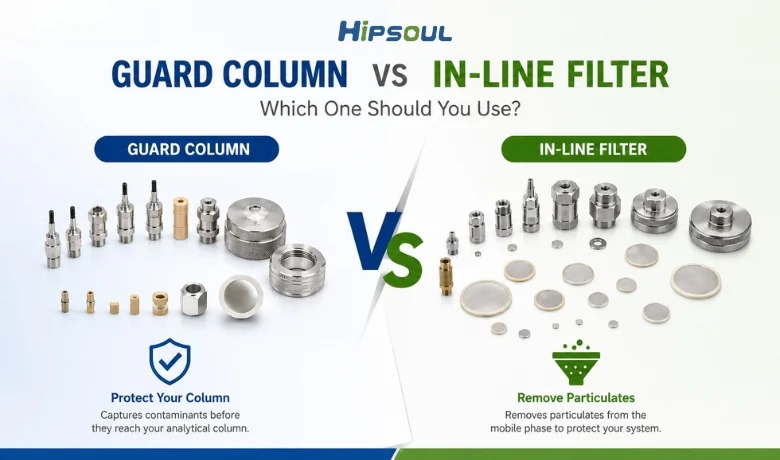
Guard Column vs In-Line Filter Which One Should You Use
If you’re choosing between a guard column and an in-line filter, the simplest answer is this:
Tips
- Use a guard column to protect the stationary-phase chemistry of your HPLC column.
- Use an in-line filter to protect the hardware and flow path from particulate contamination.
- Use both when your samples present both chemical and particulate risks.
Guard columns and in-line filters are not interchangeable. They solve different problems, and in many HPLC systems the most reliable protection strategy is to use them together.
Before reading the full guide
- If your samples may chemically contaminate the stationary phase, choose a guard column.
- If your samples contain particles, precipitates, or undissolved solids, choose an in-line filter.
- If you want maximum column lifetime and system stability, consider using both.
Proper upstream protection can help extend column life, reduce unplanned downtime, stabilize system pressure, and lower the total operating cost of an HPLC method.
In HPLC, many performance problems do not begin at the detector. They begin before the analytical column. High back pressure, baseline instability, poor peak shape, and shortened column lifetime are often blamed on the analytical column itself, even when the real cause is insufficient upstream protection.
1. What Is a Guard Column?
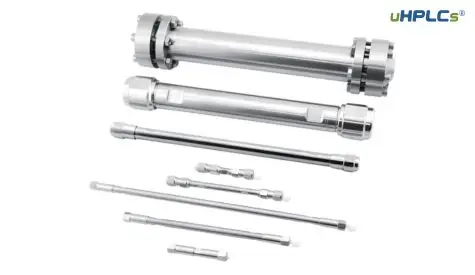
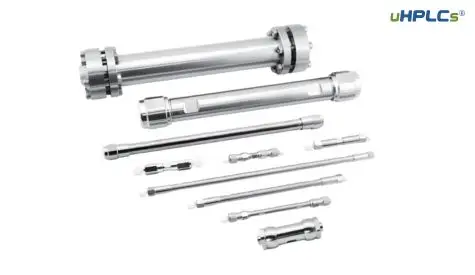
A guard column is a short, sacrificial column packed with the same or a compatible stationary phase as the analytical column. It is installed between the injector and the analytical column so that contaminants reach the guard column first.
Because it contains chromatographic packing material, a guard column behaves like a miniature chromatography column. It can retain chemical contaminants as well as trap some particulate matter.

How a guard column works
- Traps some particulate matter before it reaches the analytical column inlet.
- Retains strongly retained chemical contaminants.
- Reproduces a similar separation environment to the analytical column.
- Protects the inlet frit and stationary phase of the analytical column.
Typical stationary phases: C18, C8, phenyl, PFP, HILIC, ion-exchange, and other phase chemistries.
Typical length: approximately 5–10 mm, depending on cartridge and holder design.
Typical format: replaceable cartridge, reusable holder, or disposable pre-column assembly.
A useful way to think about a guard column is as a bodyguard: it takes chemical and physical damage before the main analytical column does.
2. What Is an In-Line Filter?
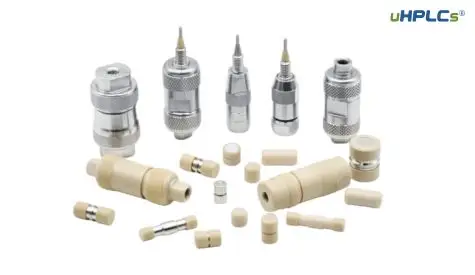
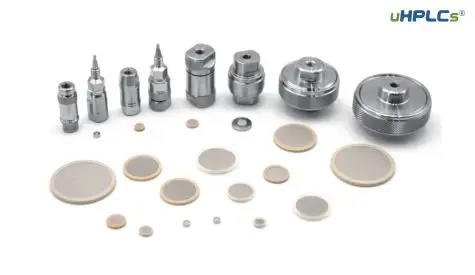
An in-line filter is a mechanical filtration device installed in the HPLC flow path, usually before the analytical column or between major system components.
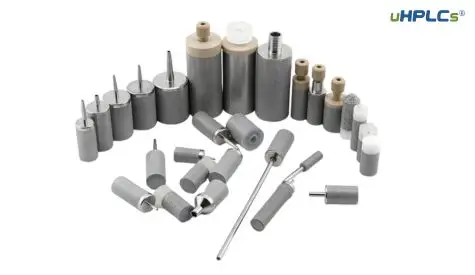
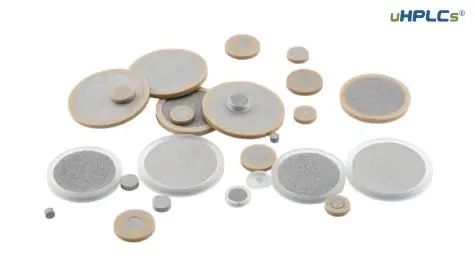
Unlike a guard column, an in-line filter does not contain a stationary phase. It uses a microporous filter element—commonly stainless steel or polymer—to physically block particles.
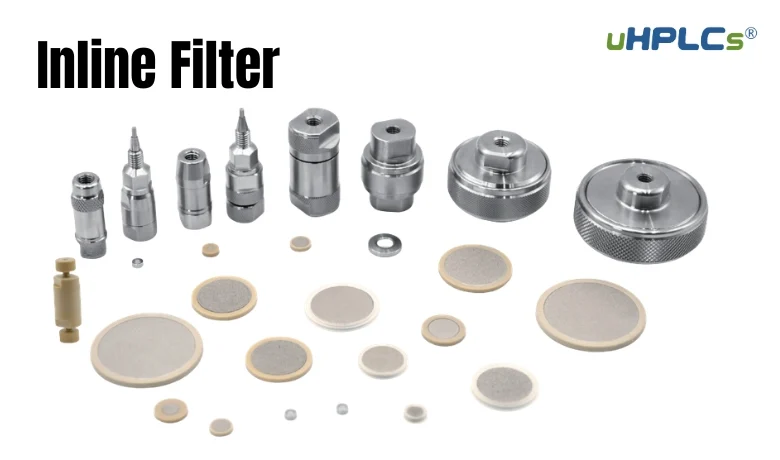
How an in-line filter works
- Physically intercepts particles and undissolved solids.
- Prevents debris from reaching the analytical column inlet frit.
- Does not provide meaningful chemical retention.
- Has little or no effect on chromatographic selectivity when correctly sized.
Common pore sizes: 0.2 μm, 2 μm, and 5 μm.
Key design goal: very low internal volume and minimal pressure drop.
Maintenance: replaceable, cleanable, or reusable elements depending on the design.
An in-line filter is more like a security checkpoint: it blocks unwanted particles while allowing the mobile phase and dissolved analytes to pass through.
3. Guard Column vs. In-Line Filter: Key Differences
| Aspect | Guard Column | In-Line Filter |
|---|---|---|
| Main function | Chemical and physical protection | Physical particle protection |
| Contains stationary phase | Yes | No |
| Effect on retention | May slightly affect retention and selectivity | Normally negligible |
| Internal volume | Higher | Extremely low |
| Added back pressure | Noticeable, especially as fouling increases | Usually minimal when clean |
| Protection from chemical fouling | Yes | No |
| Chemistry compatibility | Must match or be compatible with the analytical column | Broadly compatible when materials are suitable |
| Replacement cost | Generally higher | Generally lower |
Watch: Guard Column vs. In-Line Filter Explained
Prefer watching instead of reading? This short video explains the key differences between an HPLC guard column and an HPLC in-line filter, including when to use each and how they protect your chromatography system.
The key takeaway
A guard column protects against chemical contamination and some particles. An in-line filter protects primarily against particles. They solve different problems.
4. What Problems Does a Guard Column Solve Best?
A guard column is most effective when chemical contamination is the main risk to the analytical column.
Use a guard column when
- Samples contain strongly retained compounds.
- Biological matrices may contain proteins, lipids, or other difficult contaminants.
- Retention time gradually shifts over repeated injections.
- Peak tailing or loss of efficiency becomes progressively worse.
- Column performance degrades chemically rather than through sudden blockage.
Typical applications
- Pharmaceutical impurity analysis
- Plasma, serum, and tissue extract analysis
- Natural products and complex formulations
- Environmental samples containing persistent organic contaminants
5. What Problems Does an In-Line Filter Solve Best?
In-line filters are most effective when the main threat is particulate contamination rather than chemical fouling.
Use an in-line filter when
- The system experiences sudden pressure spikes.
- Column inlet frits clog without warning.
- The mobile phase may contain fine particles or precipitates.
- Pump seals, tubing, or fittings may generate small fragments.
- You need protection without changing retention behavior.
Typical applications
- Routine quality-control analysis
- High-throughput laboratories
- Gradient methods sensitive to extra system volume
- Systems with frequent solvent switching
- RID and other baseline-sensitive applications

6. Back Pressure: The Silent Decision-Maker
Back pressure is often the factor that determines whether a guard column, an in-line filter, or a combined configuration is practical.
| Pressure Consideration | Guard Column | In-Line Filter |
|---|---|---|
| Initial pressure contribution | Measurable | Usually very low |
| Pressure change during fouling | Often gradual | Can become more sudden and easier to identify |
| Suitability near system pressure limit | Requires careful evaluation | Often the lower-pressure option |
Important
If the system already operates close to its maximum pressure limit, adding a packed guard column may create unacceptable pressure. Always confirm system pressure margin under the actual mobile-phase composition, flow rate, temperature, and column conditions.
7. Baseline Stability and Solvent Effects
Guard columns introduce additional packed volume and connections into the flow path. Depending on the method, this may create extra mixing, additional dwell volume, or small retention effects.
A guard column may introduce
- Additional dead volume
- Extra mixing zones
- Small solvent or analyte interaction effects
- Slight changes in gradient response or retention
These effects may be more noticeable in gradient elution, refractive-index detection, low-level impurity analysis, or methods that are highly sensitive to extra-column volume.
In-line filters generally
- Have very low internal volume
- Do not contain stationary phase
- Have minimal influence on retention
- Help preserve baseline stability when correctly installed
When baseline stability and low extra-column volume are the highest priorities, an in-line filter is often the safer first choice.
8. Cost and Maintenance Considerations
| Factor | Guard Column | In-Line Filter |
|---|---|---|
| Initial cost | Usually higher | Usually lower |
| Inventory requirement | Chemistry-specific cartridges may be required | Broad compatibility reduces inventory complexity |
| Maintenance | Regular cartridge replacement | Element replacement or cleaning, depending on design |
| Risk of method impact | Incorrect chemistry can affect retention or selectivity | Low when pore size and materials are suitable |
For many routine QC laboratories, in-line filters offer a strong cost-to-benefit ratio. For chemically challenging samples or expensive analytical columns, a guard column may provide greater value.
9. Should You Use Both?
Yes, in some applications. A pre-column in-line filter followed by a guard column can provide layered protection: the filter removes particles, while the guard column captures chemically retained contaminants.
Using both may be appropriate for
- Very dirty or poorly characterized samples
- High-value analytical columns
- Validated methods that must run for long periods
- Applications with both particle and chemical contamination risks
More protection is not always better
Combining devices also increases system volume, pressure, connection count, and troubleshooting complexity. The goal should be the minimum protection configuration that reliably controls the actual contamination risk.
10. How to Choose: A Practical Decision Guide
Start by identifying whether the dominant problem is particulate contamination, chemical contamination, or a combination of both.
| Application Condition | Recommended Protection | Reason |
|---|---|---|
| Particles or undissolved solids are the main concern | In-line filter | Provides direct mechanical filtration with minimal method impact |
| Strongly retained contaminants are the main concern | Guard column | Protects the analytical stationary phase from chemical fouling |
| Method is highly sensitive to extra volume | Low-volume in-line filter | Minimizes extra-column volume and retention effects |
| Complex biological or natural-product matrix | Guard column or both | Controls both chemical contamination and particulate risk |
| System operates near its pressure limit | In-line filter | Usually adds less pressure than a packed guard column |
| Maximum protection is required | In-line filter + guard column | Provides layered physical and chemical protection |
Quick rule of thumb
- Particles only? Use an in-line filter.
- Chemical fouling? Use a guard column.
- Baseline-sensitive method? Start with a low-volume in-line filter.
- Complex sample matrix? Use a guard column, or combine both.
Final Thoughts
Guard columns and in-line filters are not competing products. They are protection tools designed for different contamination mechanisms.
The most common mistake is not simply selecting the wrong device. It is assuming that one protection device can solve every HPLC problem.
By matching the protection device to the actual failure mode, laboratories can extend column lifetime, reduce downtime, maintain stable baselines, and improve overall data quality.
Frequently Asked Questions
Can an in-line filter replace a guard column?
Not when chemical fouling is the main problem. An in-line filter removes particles but does not contain stationary phase and therefore cannot retain strongly retained chemical contaminants in the same way.
Does a guard column change retention time?
It can cause a small change because it adds packed volume and stationary phase to the flow path. The effect is usually limited when the guard chemistry and dimensions are properly matched.
Where should an in-line filter be installed?
It is commonly installed immediately before the analytical column or before a guard column. The best location depends on which system components require protection and the available connection layout.
How do I know when to replace the protection device?
A sustained increase in back pressure, declining peak shape, shifting retention, or repeated system instability may indicate that the guard cartridge or filter element is contaminated and should be serviced.
Can I use both devices in UHPLC?
Yes, provided that all components are rated for the required pressure and that the added volume, connections, and pressure drop remain acceptable for the method.
HPLC In-Line Filters and Column Protection Solutions
uHPLCs provides low-volume in-line filters, guard-column hardware, replacement filter elements, fittings, tubing, and customized chromatography protection components for laboratories, chromatography brands, and instrument manufacturers.
Available support includes pore-size selection, pressure-compatible designs, custom dimensions, connection options, private labeling, packaging, and OEM/ODM development.