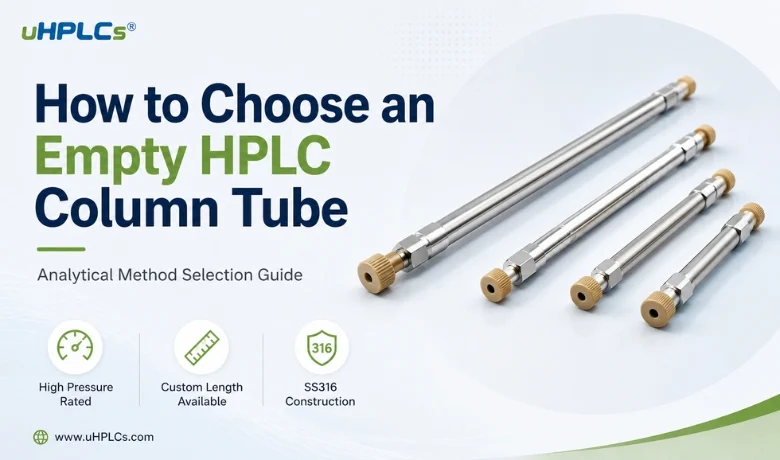
How to Choose the Right Empty HPLC Column Tube (ID, Length & Material Guide)
Selecting the correct empty HPLC column tube is a critical step when building or packing a chromatography column. While much attention is often given to stationary phase selection, the HPLC column hardware itself plays a major role in pressure resistance, chemical compatibility, and separation efficiency.
An HPLC column tube serves as the container that holds the packed stationary phase and maintains a stable flow path during analysis. The column must withstand high operating pressures while remaining chemically inert to the mobile phase and analytes.
Quick selection guide
- Choose the ID according to sensitivity, sample loading, and solvent consumption.
- Choose the length according to required resolution and analysis time.
- Choose the material according to pressure and chemical compatibility.
- Confirm pressure rating, fittings, and frit size before packing the column.
Whether you are developing a new analytical method or packing your own column, choosing the right empty HPLC column hardware can significantly affect performance, reproducibility, and column lifetime.
1. What Is an Empty HPLC Column Tube?
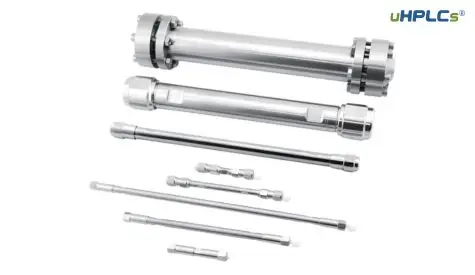
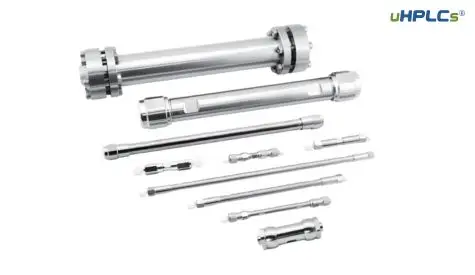
An empty HPLC column tube is the structural component of a chromatography column before the stationary phase is packed. It typically includes:
- a precision column tube
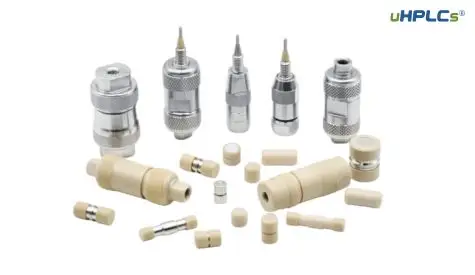
- end fittings
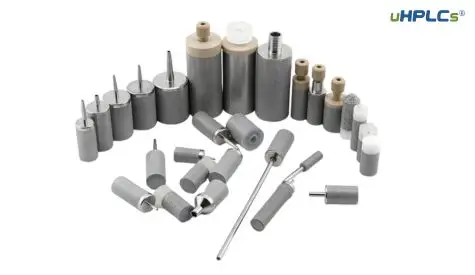
- frits
- ferrules
The tube must hold the stationary phase particles and withstand the backpressure generated during chromatographic separation. Most modern HPLC columns operate under pressures ranging from 50 to over 1000 bar, depending on particle size and system configuration.
Because of these high pressures, most column tubes are manufactured from 316 stainless steel, although materials like PEEK or titanium may also be used for special chemical compatibility requirements.
2. Key Factors When Choosing an Empty HPLC Column Tube
2.1 Material Selection
The material of the HPLC column hardware determines chemical compatibility and pressure resistance.
| Material | Key Advantages | Typical Use |
|---|---|---|
| 316 Stainless Steel | High pressure tolerance; excellent durability | Analytical, UHPLC and preparative HPLC |
| PEEK | Chemically inert; minimizes metal interaction | Biological and metal-sensitive samples |
| Titanium | Excellent corrosion resistance | Special applications requiring alternative metal compatibility |
For most analytical applications: 316 stainless steel empty HPLC column tubes remain the industry-standard choice because of their mechanical strength and broad usability.
2.2 Column Inner Diameter (ID)
Column internal diameter affects sensitivity, sample loading capacity, and solvent consumption.
| Column ID | Application |
|---|---|
| 2.1 mm | UHPLC / high sensitivity analysis |
| 3.0 mm | LC-MS methods |
| 4.6 mm | Standard analytical HPLC |
Smaller diameter columns improve sensitivity and reduce solvent consumption, while larger diameters allow higher sample loading.
2.3 Column Length
Column length directly affects separation efficiency and analysis time.
| Length | Application |
|---|---|
| 50 mm | Fast screening |
| 100–150 mm | Routine analysis |
| 250 mm | High-resolution separations |
Longer columns provide higher resolving power but also increase backpressure and run time.
2.4 Pressure Rating
Modern HPLC systems can generate extremely high pressures. Your empty HPLC column tube must be rated above the system’s maximum pressure to avoid deformation or leakage.
| System Type | Typical Pressure |
|---|---|
| Standard HPLC | Up to 400 bar |
| UHPLC | 1000+ bar |
Important: Always select hardware with an adequate safety margin above the actual operating pressure.
2.5 End Fittings and Connection Compatibility
The final factor is ensuring compatibility with your HPLC system. Key considerations include:
- 10-32 threads
- 1/16″ tubing compatibility
- low dead-volume fittings
- frit compatibility
Poor fittings can cause leaks, dead volume, and peak broadening, reducing chromatographic performance.
2.6 Frit Size
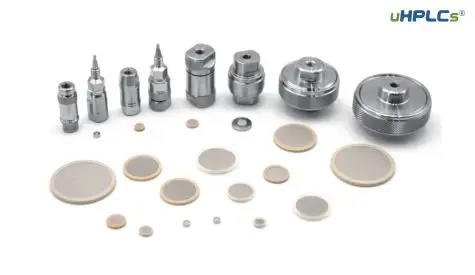
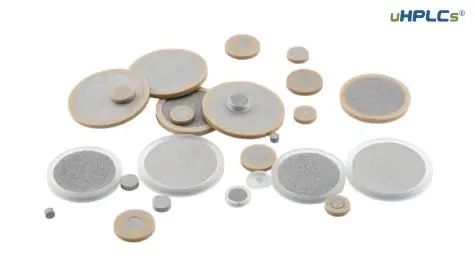
The frit is a critical component inside an empty HPLC column tube, responsible for retaining packing materials while allowing mobile phase to pass through.
- 0.2 μm frit: Ideal for UHPLC and sub-2 μm particles, ensuring maximum retention of fine packing materials and minimizing particle loss.
- 2 μm frit: Suitable for standard analytical HPLC applications using larger particle sizes (e.g., 3–5 μm).
An improper frit size may lead to packing loss, increased backpressure, or peak distortion. Therefore, the frit specification must be carefully matched to the particle size of your stationary phase.
2.7 Inner Surface Finish
The internal surface finish of the column tube plays a key role in ensuring consistent flow dynamics and minimizing unwanted interactions.
- Reduce dead volume inside the column
- Ensure uniform packing of stationary phase
- Improve peak shape and separation efficiency
- Minimize sample adsorption and carryover
A poorly finished inner surface may cause flow irregularities, peak tailing, or reduced reproducibility. For high-performance analytical and UHPLC applications, a precision-engineered inner wall is essential.
3. Recommended Column Tube Configurations by Application
Empty column hardware is widely used in pharmaceutical analysis, food safety testing, environmental monitoring, biotechnology research, and method development laboratories.
Custom column packing allows researchers to tailor stationary phases for specific separations.
| Application | ID | Length | Material |
|---|---|---|---|
| Analytical | 4.6 mm | 150 mm | Stainless Steel |
| UHPLC | 2.1 mm | 50–100 mm | Stainless Steel |
| Semi-prep | 10–20 mm | 150–250 mm | Stainless Steel |
4. How to Choose the Right Empty HPLC Column Tube: 5-Step Guide
If you’re still unsure how to select the right column tube, follow this practical 5-step guide.
Step 1. Choose ID and Length Based on Your Analysis Goals
- Small molecule analysis: 2.1–4.6 mm ID, 50–150 mm length (high efficiency and fast analysis)
- Large molecules or preparative work: 10–50 mm ID, 150–300 mm length (higher loading capacity)
Step 2. Select Material Based on Sample and Solvent Compatibility
- Corrosive solvents: Stainless steel or titanium for maximum durability
- Biochemical samples or aqueous buffers: PEEK to minimize metal interaction
Step 3. Determine the Required Pressure Rating
- High-pressure methods (UHPLC): Choose column tubes rated above the system’s maximum operating pressure
- Standard HPLC methods: Standard-pressure tubes are sufficient and more cost-effective
Step 4. Consider Connection Type and System Compatibility
Ensure that the column fittings match your HPLC system (e.g., 10-32, 1/16”, or union types) to prevent leakage, dead volume, or installation issues.
Step 5. Practical Tips for Long-Term Performance
- Always maintain a safety margin in pressure and flow rate to extend column tube lifespan
- Record performance data for different methods to optimize future selections
- Regularly inspect column tubes for corrosion, clogging, or mechanical damage
5. Common Issues and Troubleshooting
| Problem | Possible Cause |
|---|---|
| High backpressure | ID mismatch, particle clogging, or improper packing |
| Leaks | Incompatible connectors or damaged tube material |
| Poor separation efficiency | Incorrect tube length or diameter, or improper stationary phase packing |
Replacing or adjusting the empty column tube can restore method performance and ensure reproducible results. Routine maintenance and method-specific tube selection are critical for minimizing these issues.
6. Frequently Asked Questions (FAQ)
1. Can I reuse an empty HPLC column tube?
Yes, empty HPLC column tubes can be reused multiple times, provided they are properly cleaned and maintained. After each use, the column tube should be thoroughly flushed to remove residual packing materials and contaminants. However, it is essential to inspect critical components such as frits, seals, and end fittings for wear or blockage.
For high-precision analytical or UHPLC applications, even minor contamination or surface damage may affect reproducibility and peak shape. In such cases, replacing frits or using a new column tube is recommended to ensure consistent performance.
2. What is the best internal diameter (ID) for UHPLC?
For UHPLC applications, smaller internal diameters are generally preferred to achieve higher sensitivity and better resolution. The most commonly used ID is 2.1 mm, which provides an optimal balance between efficiency, solvent consumption, and system pressure.
In specialized applications, even narrower IDs (e.g., 1.0 mm or below) may be used for microflow or high-sensitivity analysis. However, smaller IDs require precise system control and high-quality column hardware to maintain stable performance.
3. Stainless steel vs PEEK — which is better?
The choice depends on the application. Stainless steel offers excellent mechanical strength and high pressure resistance, making it ideal for UHPLC and high-pressure analytical applications. PEEK provides an inert flow path and is useful for bio-related or metal-sensitive analyses.
4. What frit size should I choose?
The frit pore size should match the particle size of the stationary phase. 0.2 μm frits are recommended for UHPLC and sub-2 μm particles, while 2 μm frits are suitable for conventional HPLC with 3–5 μm particles. An incorrect frit size may lead to packing instability, increased backpressure, or peak distortion.
5. Can I customize empty HPLC column tubes?
Yes. Common customization options include internal diameter and column length, material selection, frit pore size and configuration, and end fittings or connection types. Custom column tubes are widely used in method development, scale-up purification, and OEM applications.
6. What pressure should a UHPLC column handle?
UHPLC systems typically operate at significantly higher pressures than conventional HPLC systems, often exceeding 1000 bar (15,000 psi). Column hardware should therefore be rated with an adequate safety margin. The exact rating should be confirmed for the specific hardware and operating conditions.
Conclusion
Selecting the right empty HPLC column tube requires careful consideration of tube material, size, pressure rating, and system compatibility. The right choice ensures optimal separation, reproducible results, and prolonged system lifespan. By aligning tube specifications with analytical goals, sample type, and method requirements, laboratories can achieve reliable and efficient chromatographic analyses.
Need Help Choosing an Empty HPLC Column Tube?
Tell us your required ID, length, pressure range, stationary-phase particle size, and HPLC system. Our team can help recommend or customize suitable empty HPLC column hardware for analytical, UHPLC, semi-preparative, preparative, and OEM applications.