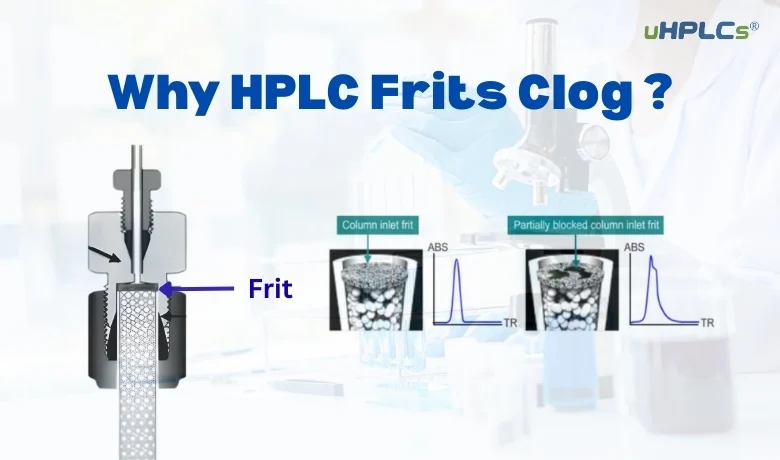
1. Introduction: What Is an HPLC Frit and Why It Matters As you know, In every HPLC system, the frit is a small but critical component that determines whether your column performs smoothly—or fails prematurely.An HPLC frit is a porous metal or polymer filter, typically positioned at several key locations in the flow path: Inlet frit (at the head of the column) Outlet frit (at the tail of the column) Guard column frits (protecting the analytical column from contamination)Inline filter frits (placed before the injector or column to trap debris)HPLC Column frits ( End cap type with peek seal ) Although tiny—usually only a few millimeters in diameter—frits play a big role.Their main job is to prevent particulate matter from entering or escaping the packed bed, ensuring consistent flow, stable backpressure, and reliable peak shape. A damaged or clogged frit disrupts all of this. Why Frit Clogging MattersFrit clogging is one of the top causes of HPLC column degradation, accounting for a large percentage of sudden backpressure spikes,unstable flow rates, and shortened column lifetimes.When particles accumulate on the frit surface or inside its pores, the system quickly develops:Rising column backpressurePoor peak shape or split peaksReduced efficiency and sensitivityIn extreme cases, complete flow blockageBecause these symptoms overlap with other HPLC issues, users often search for terms like:“Why is my HPLC pressure increasing?”“How do I prevent HPLC frit clogging?”“How to clean or replace a clogged frit?”“HPLC guard column vs inline filter—do I need both?”Understanding why frits clog and how to prevent it is essential for anyone aiming to extend column lifetime,reduce instrument downtime, and maintain consistent data quality.Looking for High-Performance HPLC Frits?uHPLCs offers a full range of precision-sintered HPLC frits, including stainless steel, titanium,and PEEK frits designed for analytical HPLC and UHPLC systems. Explore options here:👉 https://uhplcs.com/hplc-frit/ 2. Understanding How an HPLC Frit Works To understand why frits clog, it’s important to first know how they function inside an HPLC column.Although often overlooked, the frit is the first—and sometimes last—line of defense against particulate contamination in the chromatographic flow path.1.Frit Pore Sizes: Typically 0.2 μm to 5 μmHPLC frits are engineered with highly controlled pore sizes to balance flow permeabilityand particle retention. Common pore size ranges include:*0.2–0.5 μm: UHPLC-grade frits, high backpressure stability*1–2 μm: Standard HPLC column inlet frits*2–5 μm: Outlet frits, guard column frits, inline filtersThe pore size determines which particles will be trapped and how rapidly debris may accumulate.2.Common Frit Materials and Their FunctionsHPLC frits are manufactured using materials designed for chemical resistance, mechanical stability, and precise porosity:• SS316L Stainless Steel (Most Common)*Excellent corrosion resistance*Supports high backpressure*Stable across a wide pH range• Titanium*Ideal for bio-inert or metal-sensitive analytes*Excellent mechanical strength*Used in high-end UHPLC systems• PEEK (Polyetheretherketone)*Polymer-based, chemically inert*Suitable for low-pressure or metal-sensitive applications*Cannot handle ultra-high pressure like metal frits• Porous Ceramic or Glass Frits*Used in certain non-metal workflows*Fragile and less common in high-pressure systemsuHPLCs manufactures frits in all major materials to match different column designs and analytical needs.3. How the Flow Path Interacts With the FritInside the HPLC column, the frit sits directly at the entrance and exit of the packed bed:1.Mobile phase and sample enter through the inlet frit*The frit traps particles larger than its micron rating*Ensures only clean solvent reaches the packed bed2.Flow moves evenly through the stationary phase*Prevents channeling and protects bed integrity3.Mobile phase exits through the outlet frit*Retains silica fines generated from the packing material*Prevents particles from migrating downstream into valves or detectorsBecause of this strategic placement, frits are constantly exposed to particulates from both samples and column wear.4. How Debris Accumulates in the FritOver time, the frit can gradually become blocked due to:*Insoluble particles in samples*Buffer salt precipitation*Microbial contamination in aqueous mobile phases*Silica fines shed from column packing under stress*Pump seal debris or rotor-seal shavings*Aggregated proteins, lipids, or polymersThese materials collect on the frit surface, inside the pore structure, or at the packed-bed interface,eventually restricting flow and raising system pressure.5. (Optional) Illustration ReferenceIf illustrating this section, recommended visuals include:*Cross-section diagram of an HPLC column showing frit location*Magnified frit structure showing pore network*Schematic of debris accumulation patternsI can generate a diagram-style textual illustration or a full infographic prompt for your designer if needed. 3. The Real Reasons Why HPLC Frits Clog HPLC frit clogging is rarely caused by a single factor. Instead, it results fromthe combined effects of sample impurities, buffer chemistry, instrument wear, and user operation habits.Understanding these root causes helps prevent costly downtime and premature column failure.Below, we break down the real-world causes into five major categories.3.1 Sample-Related CausesThe sample is one of the biggest contributors to frit contamination. Even trace amounts of insoluble or partially soluble material will accumulate over time.• Insoluble ParticulatesCommon in environmental, food, and industrial samples. Even after centrifugation, micro-level debris can slip through and block 0.5–2 µm frit pores.• Protein PrecipitationProteins tend to denature and aggregate in:*high organic conditions (ACN, MeOH)*elevated temperatures*pH extremesThese aggregates rapidly form a “protein cake” on the inlet frit.• Lipids, Polymers, and SurfactantsThese components can:*adsorb to the frit surface*create sticky layers that trap other particles*form gels under certain solvent conditionsEspecially common in biological, pharmaceutical, and food matrices.• Dirty or Complex Sample MatrixEnvironmental, soil, wastewater, and plant extracts contain:*fibers*colloids*humic substances*particulate contaminantsThese load onto the frit long before affecting the main column bed. 3.2 Mobile Phase & Buffer IssuesYour mobile phase can unintentionally become the main source of clogging if not prepared and handled correctly.• Salt CrystallizationBuffers such as phosphate, ammonium sulfate, or high-salt solutions crystallize when:mixed with high organic solventstored too longexposed to evaporationCrystals easily lodge into frit pores.• High-Concentration Phosphate BuffersPhosphates can precipitate at >50% organic or under temperature fluctuations.This is one of the most common causes of sudden pressure spikes.• Incompatibility With Organic SolventsSwitching abruptly from:100% aqueous → 100% organicorion-pairing buffers → organic solventscan cause immediate precipitation, blocking the frit.• Microbial Growth in Aqueous BuffersAged buffers grow:bacteriafungibiofilmThese form stringy or gelatinous residues that rapidly clog inlet frits.3.3 Instrumental & System CausesEven with clean samples and fresh mobile phases, the HPLC instrument itselfmay generate contaminants that migrate toward the frit.• Pump Seal DebrisWorn pump seals release:polymer fragmentsrubber shavingsinorganic debris from piston wearThese accumulate directly on the inlet frit.• Flow Rate Spikes or Pressure PulsationSudden pressure changes can:disturb the packed bedforce fines toward the fritembed particles deeper into the frit structure• Contaminated Solvent ReservoirDust or microbial contamination from unfiltered or reused solvents introduces unwanted particulates.• Deteriorated Injection Valve Rotor/SealAging rotors release microscopic fragments that travel downstream and lodge in the frit. 3.4 Column Packing & Stationary Phase CausesHPLC columns naturally generate silica fines over time. Under stress, this increases drastically.• Fines Generated From Column Bed CollapseBed collapse happens due to:extreme backpressurehigh sample loadsincorrect solvent conditionsmechanical shockThe released fines quickly congest the inlet frit.• Broken or Fractured Silica ParticlesMechanical stress causes silica particles to crack and shed.These fragments move with the mobile phase until trapped by the frit.• Excessive Backpressure Leading to Internal SheddingIf pressure exceeds column limits, particles detach and clog frits from the inside out. 3.5 User Operation ErrorsHuman error is still one of the most common—and most preventable—causes of frit clogging.• Lack of Proper Sample FiltrationSkipping 0.22 μm or 0.45 μm filtration leads to large particulates immediately blocking the frit.• Sudden Change in Mobile Phase CompositionAbrupt shifts cause:buffer precipitationstationary phase swelling/shrinkagetrapped particles to dislodge and migrate to the inlet frit• Improper Column StorageStoring columns in buffer for long periods encourages salt deposition and microbial formation on the frit surface.• Using Expired or Degraded BuffersOld buffers tend to:precipitate outgrow microbial filmslose chemical stabilityAll of these quickly obstruct a frit. 4. Symptoms That Indicate the Frit Is Clogged A clogged HPLC frit rarely fails all at once. Instead, it shows progressive warning signsthat can easily be mistaken for pump issues, column aging, or method problems.Recognizing these symptoms early allows you to prevent irreversible column damageand restore proper system performance.Below are the most common indicators that your HPLC inlet or outlet frit may be obstructed.1.Gradual Rise in System BackpressureOne of the first signs of frit clogging is a slow, continuous increase in backpressure over several runs.This indicates debris is progressively blocking the pore channels, reducing flow permeability.Typical pattern:*Pressure increases by 5–20 bar per injection*No major change in chromatographic performance yet2.Sudden Column Pressure SpikesIf particulate loading reaches a critical level, the system may show:*sharp pressure jumps*pressure oscillation*immediate overpressure alarmsThis typically occurs when:*salts crystallize*protein aggregates form*pump seal debris reaches the inlet frit all at once3. Peak Broadening or Peak SplittingA partially clogged frit creates non-uniform flow distribution, especially at the column inlet.Symptoms include:*broader peaks*distorted peak shapes*fronting or tailing*split peaksThese chromatographic distortions occur because the sample no longer enters the packed bed uniformly.4.Reduced Sensitivity or Sample Carry-OverA blocked frit affects the consistency and volume of sample transfer, leading to:*decreased signal intensity*poor reproducibility*unexpected carry-overCarry-over occurs when sample debris accumulates on the frit surface and slowly leaches back into subsequent injections.5.Flow Rate Instability or Pump PulsationA partially obstructed frit increases flow resistance. The pump compensates, causing:*unstable baseline*variations in flow rate*retention time shiftsIf the pump is functioning correctly but flow instability persists, the frit is a prime suspect.Diagnostic Table: Symptoms and Likely CausesSymptomLikely CauseRelated to Frit?Gradual rise in backpressureAccumulation of particulates, silica fines, salt precipitationYes — early-stage cloggingSudden pressure spikeProtein aggregation, salt crystallization, pump debrisYes — acute cloggingPeak broadening or splittingNon-uniform flow distribution at inlet fritYes — strong indicatorReduced sensitivityIncomplete sample transfer across fritOftenCarry-overAdsorbed matrix residues on frit surfaceOftenFlow instabilityFrit resistance causing pump compensationPossibleDetector noise or baseline driftMobile phase contaminationIndirect — may appear similarRetention time shiftsVariable flow caused by frit blockageOftenHope this table can helpful and also this table can also help your customers differentiate frit issues from pump, injector, or solvent problems. 5. How to Troubleshoot a Clogged HPLC Frit When your HPLC system begins showing signs of increased pressure, poor peak shape, or unstable flow,it’s essential to troubleshoot the frit as a potential cause.Because many symptoms overlap with pump or mobile-phase issues, a structured diagnostic approachhelps isolate whether the frit is truly the problem. Here, we supply two methods , you can check details which one is good for you situation . 5.1 Step-by-Step Diagnosis Checklist StepWhat to CheckHow to EvaluateWhat It Means1. Verify Pump PressurePump seals, pulsation, baseline pressureRun low flow (0.1–0.2 mL/min) and observe pressure stabilityIf unstable → Instrument issue, not the frit2. Check Mobile PhaseSolvent clarity, salt solubility, buffer freshness, microbial growthReplace with fresh filtered mobile phaseIf pressure drops → Solvent/buffer issue, not frit clogging3. Bypass the ColumnColumn vs system discriminationConnect tubing directly (no column attached)If pressure normal → Problem is in column or guard column4. Inspect Guard ColumnGuard column frit blockageRemove guard column and re-testNormal pressure → Guard column frit is clogged5. Evaluate Autosampler & Rotor SealRotor seal wear, particulate sheddingInspect for debris, leaks, injection inconsistencyWorn rotor seals send debris → Causing frit clogging5.2 Methods to Confirm the Frit Is the Actual Problem Confirmation MethodProcedureIndication of a Clogged FritReverse-Flush the Column (if allowed)Reverse flow direction at low flow; flush with strong solvent; monitor pressureSignificant pressure drop → Debris removed from inlet fritRemove Guard Column & Re-TestConnect analytical column directlyHigh pressure persists → Main column inlet frit is cloggedCompare Operating Pressure vs BaselineCompare current pressure to typical method baseline+20–50 bar increase or more → Strong indicator of frit obstruction 6. Can You Clean a Clogged HPLC Frit? (Myth vs Reality) — Checklist Version One of the most common questions from chromatographers is whether a clogged HPLC frit can be cleaned or recovered.The answer is sometimes yes—but often no. Because frits are made from tightly sintered metal or polymer materials,debris trapped deep inside the pore network is extremely difficult to remove.Below is a realistic view of when cleaning works, when it doesn’t, and when replacement is the smarter choice.✅ Checklist: Cases Where Cleaning Is PossibleCleaning may work only in mild or early-stage contamination, such as:☐ Light particulate buildup on the frit surface☐ Early salt or buffer precipitation (recent, not embedded)☐ Debris that dissolves easily in strong solvents☐ Columns that explicitly allow gentle backflushing☐ Blockages caused by short-term environmental dust or sample particulates☐ Mobile phase miscibility issues resolved quicklyCleaning methods that sometimes work:☐ Warm water flush☐ Acidic/basic rinse (depending on buffer chemistry)☐ 100% organic solvents (MeOH, ACN, IPA)☐ Low-flow, manufacturer-approved backflushing❌ Checklist: Cases Where Cleaning Fails (Most Common)Cleaning almost always fails when dealing with:☐ Protein precipitation or aggregates☐ Lipids, surfactants, polymers forming sticky films☐ Silica fines from column packing shedding☐ Broken packing particles deeply embedded in pores☐ Mechanical debris from pump or rotor seal wear☐ Long-term or heavy salt crystallization☐ Bed collapse releasing large quantities of fines☐ Organic–aqueous incompatibility causing hard precipitatesIf any of these apply → Cleaning is unlikely to restore performance.⚠️ Checklist: Risks of Trying to Clean a FritAttempting aggressive cleaning may cause further damage:☐ Excessive backpressure → packing bed deformation☐ Loss of column efficiency☐ Void formation or channeling inside the column☐ Corrosion or chemical damage to metal frits☐ Swelling or degradation of PEEK frits☐ Damage to stationary phase chemistry☐ Apparent recovery of pressure but permanent decline in performanceIf multiple risks apply → Cleaning is not recommended.🔁 Checklist: When to Replace Instead of RecoverYou should replace the frit, guard column, or column when:☐ Pressure remains high after backflushing☐ Peak shape does NOT improve after cleaning☐ Column shows poor efficiency or broad peaks☐ Blockage is caused by silica fines or mechanical particles☐ Frit material is incompatible with cleaning solvents☐ Column has exceeded its expected lifetime☐ Guard column or inline filter replacement is inexpensive☐ Severe salt or protein buildup is present☐ Bed collapse or internal shedding is suspectedIf several boxes are checked → Replacement is the correct solution. 7. Prevention: How to Stop HPLC Frits From Clogging While frit clogging is common, it is also highly preventable with the right upstream workflow, system maintenance,and operational habits.The following best practices significantly extend column lifetime, improve chromatographic stability,and reduce instrument downtime. 7.1 Upstream Sample ProtectionMost frit blockages originate from dirty or incompletely prepared samples. Strengthening sample pretreatment has the highest impact.• Use 0.22 μm or 0.45 μm Syringe FiltersFiltration is the simplest and most effective method to prevent particulates from entering the system.*0.45 μm → suitable for general HPLC samples*0.22 μm → recommended for biological, pharmaceutical, and UHPLC samplesNever inject unfiltered samples—even “clear-looking” samples contain micro-particulates.• Use SPE or Additional Filtration for Complex SamplesFor samples with proteins, fats, or heavy matrix:*Solid Phase Extraction (SPE)*Centrifugation + filtration*Protein precipitation followed by cleanup*QuEChERS extraction for food/environment samplesThese workflows remove matrix components that easily clog frit pores.*Recommended Filtration WorkflowA typical protection workflow:1.Sample homogenization2.Centrifugation3.0.45 μm or 0.22 μm filtration4.InjectionFor biological samples, add:5.SPE or protein removal step6.Inline filter before column (optional)7.2 System-Level ProtectionProtecting the system itself ensures contaminants do not reach the column.• Install Inline Filters (0.5 μm or 2 μm)Inline filters act as sacrificial barriers before the column.Benefits:*Catch pump seal debris*Protect the inlet frit*Extend column lifetimeuHPLCs inline filters are designed for both HPLC and UHPLC pressure ranges.*Use a Guard Column (C18, HILIC, SEC, etc.)Guard columns trap particles and matrix residues before they reach the analytical column.Use matching chemistries:*C18 guard → C18 analytical column*HILIC guard → HILIC analytical column*SEC guard → SEC columnReplacing a guard column costs far less than replacing a main column.*Regularly Replace Pump Seals and Rotor SealsMechanical wear produces polymer fragments that clog frits.Maintenance schedule (typical):*Pump seals: every 6–12 months*Rotor seal: every 3000–5000 injectionsProactive replacement prevents internal particle generation.7.3 Best Practices for Mobile Phase PreparationYour mobile phase must be as clean and stable as your samples.• Filter All Solvents and BuffersUse 0.2–0.45 μm filtration to remove undissolved particles.• Avoid Crystallization-Prone BuffersHigh-concentration phosphate or sulfate buffers can precipitate when mixed with organic solvents.• Replace Buffers Every 2–3 DaysAqueous buffers degrade quickly, forming:*microbial growth*insoluble salt crystals*pH instability• Degas and Protect Against Microbial GrowthUse:*Inline degassers*Sonication*UV sterilizationFreshly prepared solvents stored in clean glassware7.4 Daily User Operation HabitsGood laboratory habits directly extend column and frit lifetime.• Proper Column Washing ProtocolAfter each session:*Flush with high-organic solvent for reversed-phase columns*Flush with high-aqueous solvent for HILIC columns*Remove buffer before shutdown to avoid crystallization• Correct Startup & Shutdown ProcedureAvoid starting the system with:*empty lines*dried-out pumps*buffer residues in linesDuring shutdown:*Never leave the column stored in buffer for long periods*Store in appropriate solvent recommended by manufacturer• Avoid Sudden Mobile Phase ChangesDrastic changes can cause immediate precipitation.Avoid switching:*100% water → 100% ACN*ion-pairing buffers → strong organic solventsTransition gradually to protect the frit and packing material. 8. How to Select the Right HPLC Frit for Your Application ? Choosing the correct frit ensures stable backpressure, protects the packed bed, and improves column lifetime.The key factors are pore size, material, thickness, sintering quality, and pressure rating (HPLC vs UHPLC).8.1 Pore Size Selection (Quick Table)Pore SizeBest UseNotes0.2–0.5 μmUHPLC, protein samples, fine silica retentionHighest protection; highest pressure1 μmHigh-performance HPLCGood balance of retention & flow2 μmStandard HPLC inlet fritMost common choice3–5 μmOutlet frits, inline filtersLowest backpressureRule of thumb:*Inlet frits: 0.5–2 μm*Outlet frits: 2–5 μm*UHPLC: 0.2–0.5 μm8.2 Stainless Steel vs Titanium vs PEEKStainless Steel (SS316L)*Strong, corrosion-resistant, UHPLC-capable*Best for general HPLC and routine analysesTitanium*Bio-inert, metal-free interactions*Ideal for proteins, peptides, metal-sensitive analytesPEEK*Polymer-based, chemically inert*Not suitable for UHPLC pressures8.3 Frit Thickness & Sintering Quality*Thicker frits = stronger + more debris capacity*Thinner frits = lower pressure but easier to deform*High-quality sintering ensures uniform pore size and durability8.4 UHPLC Compatibility (10–20K psi)For UHPLC, choose frits with:*0.2–0.5 μm pore size*Titanium or high-strength SS316L*High-pressure rating (600–1300 bar)Not suitable for UHPLC: PEEK and ceramic frits 9. Industry Use Cases: Why Frit Clogging Happens More Often Application / IndustryWhy Clogging HappensTypical Effects on FritsBiological Samples (Proteins, Peptides)Protein precipitation, peptide aggregation, denaturation in organic solventsRapid inlet frit blockage, pressure spikes, distorted peaksEnvironmental Samples (Soil, Wastewater)Suspended solids, humic substances, micro-particles, colloidsGradual pressure increase; particulate buildup on frit surfacePharmaceutical API + ExcipientsInsoluble excipients, crystallization during gradients, partially soluble fillersMixed precipitates clog pores; unstable backpressurePolymer AnalysisPolymers form gels, sticky residues; additives leave particulatesFast clogging due to sticky layers and trapped particlesFood Samples (Lipids, Sugars)Lipids coat frit surface; sugars crystallize or caramelizeHeavy matrix fouling; hydrophobic films retain debris 10. uHPLCs Solutions: High-Performance Frits for Better Column Protection uHPLCs provides a full range of high-precision HPLC and UHPLC frits engineered to deliver consistent flow, stable backpressure,and long column lifetime. Whether for standard HPLC, UHPLC, or specialized bio-inert workflows,uHPLCs offers reliable frit solutions tailored to your analytical needs.10.1 Product Types Offered by uHPLCs• Standard HPLC Frits (SS316L, Titanium, PEEK)Designed for routine analyses across pharmaceutical, environmental, food, and chemical testing workflows.Available in multiple micron ratings and diameters.• UHPLC FritsPrecision-sintered metal frits rated for 10,000–20,000 psi, ideal for sub-2 μm particle columns and high-pressure systems.• Guard Column FritsPrevents contamination of the analytical column by capturing particulates and matrix residues upstream.• Inline Filter FritsSacrificial frits used before the injector or column to intercept pump seal debris, buffer crystals, and sample particulates.• Customized Frits (OEM Services)Tailored solutions including:*Specific pore sizes*Custom diameters and thicknesses*Material choices (SS316L, titanium, PEEK)*Batch-matched consistency for instrument manufacturers 10.2 Why Choose uHPLCs Frits?• Precise Micron RatingsEngineered pore sizes from 0.2–5 μm ensure accurate particle retention and predictable pressure performance.• High Sintering ConsistencyUniform pore networks provide stable flow distribution and reduced clogging risk.• High Mechanical StrengthSuitable for both HPLC and UHPLC pressures, with excellent durability under demanding solvent and temperature conditions.• OEM Support & Engineering ExpertiseuHPLCs supports:*Custom design*Rapid prototyping*Private-label manufacturing*Long-term stable supply for instrument and column manufacturers 11. Frequently Asked Questions (FAQ) 1. How often should I change an HPLC frit?There is no fixed schedule; replace the frit whenever backpressure rises, peak shape deteriorates, or when the guard column shows signs of clogging.For routine use, many labs replace frits every 1–3 months depending on sample cleanliness.2. Can a frit damage the column if clogged?Yes. A clogged frit restricts flow, causing:elevated backpressureuneven flow entering the packed bedpotential bed collapseIgnoring a clogged frit can permanently damage the analytical column.3. What's the ideal pore size for protein samples?For protein, peptide, and biological samples:0.2–0.5 μm (UHPLC-grade inlet frits)This prevents aggregates and denatured proteins from entering the packed bed.4. Do UHPLC frits clog faster?Yes. UHPLC frits use very small pores (0.2–0.5 μm), which trap more fines and particulates.Their higher sensitivity makes proper sample filtration essential.5. Can I use backflushing to clean frits?Sometimes. Backflushing can remove surface-level debris, but it cannot clear deep pore blockage.Only do this if the column manufacturer approves backflushing for your model.6. Why is my system pressure still high after changing the frit?Possible reasons include:Guard column is cloggedPump seal or rotor seal is shedding debrisMobile phase contains precipitates or microbial growthPacking bed collapse inside the columnInline filters or tubing are obstructedChanging the frit alone may not fix the underlying cause. 12. Conclusion HPLC frit clogging is a common issue that leads to high backpressure, poor peak shape, and reduced column life—but it’s also highly preventable. By applying proper sample filtration, maintaining clean mobile phases, using guard columns and inline filters, and choosing the right frit materials and pore sizes, you can greatly extend the performance and lifetime of your HPLC system.A proactive filtration workflow is the simplest and most effective way to avoid downtime and protect your analytical columns.Contact uHPLCs for High-Performance Frits and Protection SolutionsuHPLCs offers precision-engineered HPLC frits, inline filters, guard columns, and OEM customization for both HPLC and UHPLC applications.👉 Contact uHPLCs for OEM HPLC frits, inline filters, and guard columns.Related Products*HPLC Frits → https://uhplcs.com/hplc-frit/*Inline Filters → https://uhplcs.com/inline-filter/*Guard Columns → https://uhplcs.com/guard-column/*HPLC Columns → https://uhplcs.com/hplc-column/