Introduction
Ever wondered how scientists ensure your medicine is pure, or your drinking water is safe?
The answer often lies in High-Performance Liquid Chromatography (HPLC)
— a powerful analytical technique capable of separating, identifying, and quantifying components in complex mixtures.
Known for its high resolution, reproducibility, and versatility, HPLC can handle a wide range of compounds,
from small organics to large biomolecules. Because it can be paired with various detectors
—such as UV, fluorescence, or mass spectrometry—HPLC provides unparalleled precision and sensitivity.
This is why it has become indispensable across industries like pharmaceuticals, food, environmental science, and chemical manufacturing.
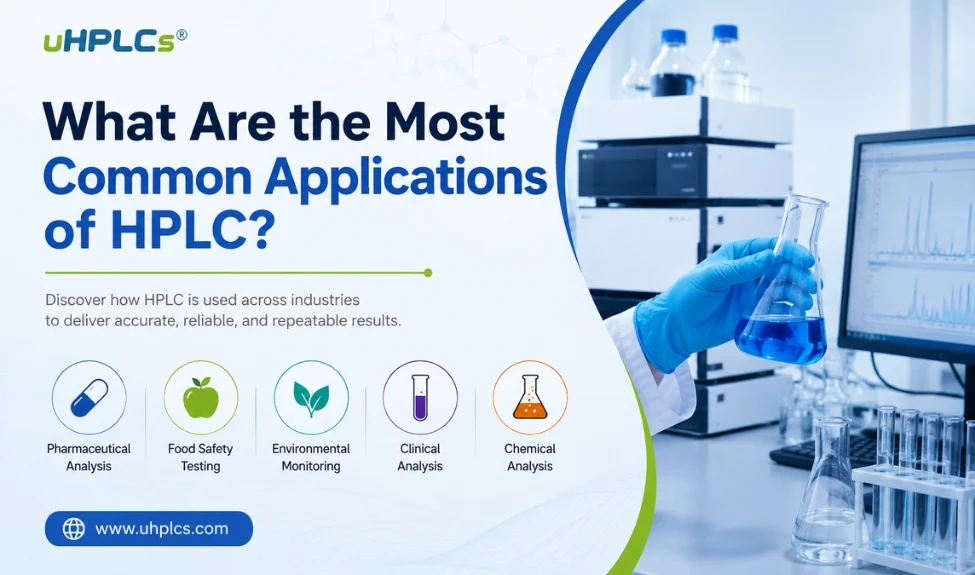
1. Pharmaceutical Industry: The Core Application Field
The pharmaceutical sector remains the most significant user of HPLC technology. From drug discovery to quality control, nearly every step in the drug development process relies on it.
Purity Testing: HPLC verifies the purity and potency of active pharmaceutical ingredients (APIs) and finished dosage forms. Regulatory agencies such as the FDA and ICH require validated HPLC methods to ensure drug safety and efficacy.
Impurity Profiling: Even trace levels of degradation products can affect safety. HPLC’s sensitivity enables detection of impurities at parts-per-million or even parts-per-billion levels.
Pharmacokinetic Studies: By analyzing blood and plasma samples, HPLC helps track how drugs are absorbed, distributed, metabolized, and excreted in the human body.
Without HPLC, the pharmaceutical industry could not ensure the consistency, stability, and safety of modern medicine.
2. Food and Beverage Analysis: Ensuring What We Eat Is Safe
HPLC also plays a crucial role in verifying the quality and safety of food and beverages.
Nutritional Analysis: It accurately quantifies essential nutrients like vitamins, amino acids, sugars, and organic acids. For example, reversed-phase HPLC (RP-HPLC) with diode array detection (DAD) is widely used to determine vitamin C and B-group vitamins in juices and supplements.
Additive and Contaminant Testing: It identifies preservatives, artificial sweeteners, colorants, and pesticide residues, helping producers comply with international food safety standards such as the Codex Alimentarius.
From your morning coffee to your bottled juice, HPLC ensures every sip and bite meets strict regulatory and nutritional standards.
3. Environmental Monitoring: Protecting Our Planet
Environmental scientists depend on HPLC to detect pollutants and monitor ecosystem health.
Water Quality Testing: HPLC identifies trace concentrations of herbicides, pharmaceuticals, and other organic contaminants in drinking water, wastewater, and groundwater.
Air and Soil Analysis: It can also measure volatile organic compounds (VOCs) and industrial chemicals.
Combined with mass spectrometry (LC–MS), HPLC achieves ultra-low detection limits—down to parts per trillion (ppt). This capability is critical for monitoring emerging pollutants such as PFAS (per- and polyfluoroalkyl substances) and microplastics, ensuring sustainable environmental protection.
4. Clinical and Biomedical Research: Understanding the Human Body
In clinical and biomedical research, HPLC helps decode the complex chemistry of life.
Biomarker Detection: It quantifies peptides, proteins, and metabolites for disease diagnostics and personalized medicine.
Hormone and Drug Analysis: HPLC accurately measures hormones like cortisol or trace drug concentrations in blood and urine samples.
Metabolomics: By combining HPLC with tandem mass spectrometry (LC–MS/MS), scientists can map entire metabolic pathways to understand disease mechanisms and drug effects.
Its ability to separate complex biological mixtures makes HPLC a cornerstone of modern life science research.
5. Chemical and Petrochemical Applications: Ensuring Product Consistency
In the chemical and petrochemical industries, HPLC provides precise process monitoring and product quality assurance.
Purity and Composition Testing: It evaluates raw materials, intermediates, and final chemical products to maintain formulation accuracy.
Process Control: HPLC helps monitor reaction kinetics and optimize production efficiency.
For example, in polymer and lubricant analysis, HPLC equipped with refractive index (RI) or evaporative light scattering detection (ELSD) determines additive composition and molecular uniformity.
6. Natural Products and Forensic Science
HPLC’s versatility extends to fields like natural product research and forensic science.
Natural Products: In herbal medicine and nutraceuticals, HPLC quantifies active ingredients such as flavonoids and alkaloids. Coupled with solid-phase extraction (SPE) and gradient elution, it provides reliable results even in complex plant matrices.
Forensic Analysis: Forensic laboratories use HPLC to detect drugs, poisons, and inks or dyes from questioned documents. Fast, sensitive, and accurate, it plays a vital role in toxicology and criminal investigations.
Conclusion
From pharmaceutical production to environmental protection, HPLC has become one of the most indispensable analytical tools in modern science. Its precision, reproducibility, and adaptability make it a trusted method for ensuring safety, compliance, and innovation across industries.
As technology evolves, HPLC continues to integrate with automation and AI-driven data analysis, further improving efficiency and detection accuracy. It’s not just a laboratory instrument—it’s a foundation for quality, safety, and scientific discovery.
If you’re looking for reliable HPLC columns, reference standards, or customized analytical solutions, uHPLCs is your trusted partner. With advanced manufacturing, in-house R&D, and the proprietary “Profiling within 5 Minutes” rapid testing system, uHPLCs delivers high-efficiency, high-accuracy chromatography solutions trusted by global pharmaceutical and research institutions in over 30 countries.
Contact us at [email protected] today to see how our cutting-edge chromatography products can help accelerate your analysis and empower your research.