1. Introduction
High-Performance Liquid Chromatography (HPLC) is a powerful and widely used analytical technique in chemistry, pharmaceuticals, environmental testing, food safety, and many other fields. It allows scientists to separate, identify, and quantify components in complex mixtures with high precision and accuracy.
As a fundamental part of HPLC analysis, retention time (RT) serves as one of the most important parameters in interpreting chromatographic results. Retention time is the time elapsed between the injection of a sample and the detection of a specific compound as it elutes from the chromatography column. It acts as a unique “fingerprint” that helps analysts recognize and differentiate compounds within a mixture.
Accurate retention time measurement is essential not only for identifying unknown substances but also for ensuring method reproducibility and optimizing chromatographic conditions during method development.
2. What Is Retention Time?
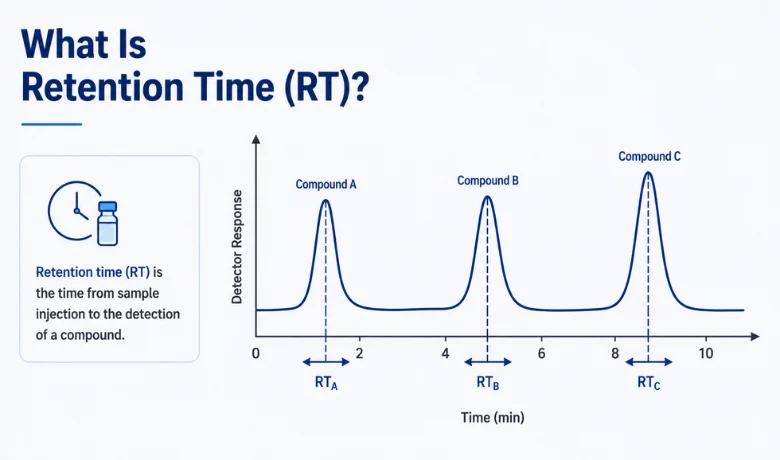
Retention time (RT) is the period between the moment a sample is injected into an HPLC system and the moment a specific analyte is detected by the detector. In a chromatogram, retention time corresponds to the position of a peak along the time axis and serves as one of the most important parameters for compound identification.
Simply put, retention time indicates how long a compound remains inside the chromatographic system before eluting from the column. Compounds that interact weakly with the stationary phase typically elute earlier and have shorter retention times, while compounds with stronger interactions remain in the column longer and exhibit higher retention times.
Retention time is usually expressed in minutes, although seconds may be used in fast chromatographic methods. For example:
- *Compound A may elute at 1.2 minutes
- *Compound B may elute at 6.5 minutes
The difference in retention times allows chromatographers to separate and identify individual components within a mixture.
In a typical chromatogram, retention time is displayed on the x-axis, while detector response is shown on the y-axis. Each peak represents a specific analyte, and the location of the peak apex on the x-axis defines its retention time.
Why Is Retention Time Important?
Retention time plays a critical role in chromatographic analysis because it helps:
✔ Identify compounds by comparing observed RT values with reference standards
✔ Evaluate method reproducibility and system performance
✔ Monitor column condition and chromatographic stability
✔ Detect potential issues such as mobile phase inconsistencies, temperature fluctuations, or system contamination
Under stable operating conditions, retention times should remain relatively consistent from run to run. Significant changes in retention time are often an indication of underlying system or method problems that require investigation.
3. Factors That Affect Retention Time
Retention time in HPLC is influenced by a variety of factors related to the chromatographic system and the properties of the analyte. Understanding these factors is essential for developing robust, reproducible methods and troubleshooting unexpected shifts in RT.
3.1. Column-Related Factors
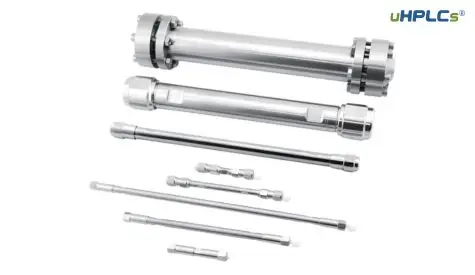
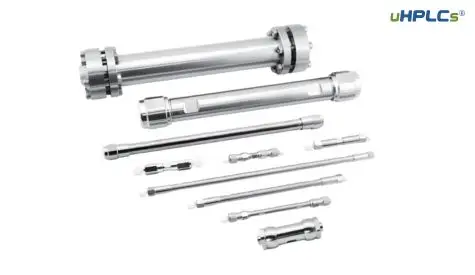
·Column Length and Diameter
Longer columns generally result in longer retention times due to the increased path the analytes must travel. Narrower internal diameters can improve sensitivity but may also affect flow dynamics and retention behavior.
·Particle Size
Smaller particles (e.g., 1.8–3 µm) offer better separation efficiency but increase system back pressure. Larger particles (≥5 µm) reduce pressure but can yield broader peaks.
·Stationary Phase Chemistry
The chemical nature of the stationary phase (e.g., C18, phenyl, cyano) determines the strength of interaction between analytes and the column, directly influencing retention time.
3.2. Mobile Phase Conditions
·Solvent Composition
In reversed-phase HPLC, increasing the percentage of organic solvent (e.g., acetonitrile or methanol) generally reduces retention time by weakening interactions with the stationary phase.
·pH and Buffer Concentration
Analyte ionization varies with pH, affecting polarity and retention. Buffer concentration also influences analyte retention and peak shape, especially for ionizable compounds.
3.3. Temperature
Column temperature affects viscosity, diffusion, and analyte-stationary phase interactions. Higher temperatures usually decrease retention time but may also alter selectivity and resolution.
3.4. Flow Rate
Higher flow rates lead to shorter retention times, as analytes travel through the column faster. In isocratic conditions, this relationship is predictable; under gradient conditions, it becomes more complex.
3.5. Sample Characteristics
·Polarity: More polar compounds elute faster in reversed-phase systems and slower in normal-phase systems.
·Molecular Weight: Larger molecules may diffuse more slowly or interact more with the stationary phase.
·Ionization State: Charged compounds can exhibit stronger or weaker interactions depending on pH, buffer, and stationary phase properties, impacting their retention.
4. How Retention Time Is Used
Retention time is more than just a measurement — it’s a vital tool in analytical chemistry that supports compound identification, method validation, and system performance monitoring.
·Compound Identification
Each compound has a characteristic RT under specific conditions. By comparing the RT of an unknown peak to that of a known standard, analysts can confidently identify substances in complex mixtures.
·Method Reproducibility and System Monitoring
Consistent RT values across multiple injections or days indicate stable system performance. Significant shifts in RT can signal issues such as pump inconsistency, column degradation, or mobile phase instability.
·System Suitability Testing (SST)
Regulatory guidelines require SST to confirm an HPLC system is working correctly. Retention time is often a part of SST criteria, ensuring that peaks appear within an acceptable time window.
·Use of Internal Standards
Including an internal standard— a compound with a known RT— helps correct for minor shifts in RT and enhances quantitative accuracy by providing a consistent reference point.
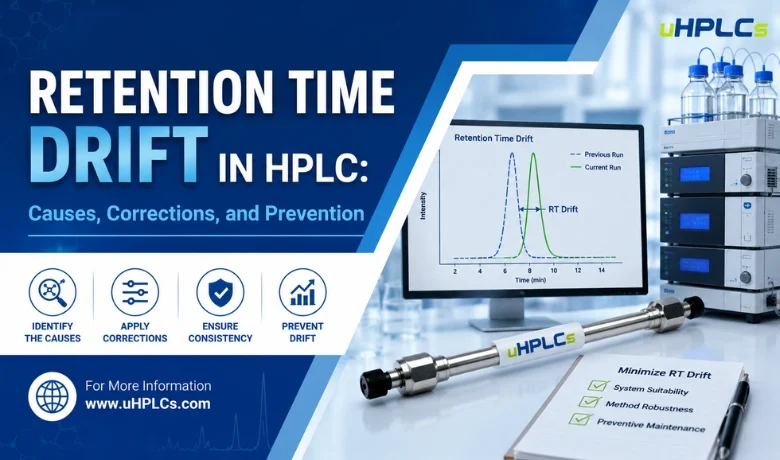
5. Retention Time Drift: Causes and Corrections
What Is Retention Time Drift?
Retention time drift refers to the gradual or sudden shift in the time a compound takes to elute from the HPLC column. This phenomenon can make it difficult to identify or quantify analytes accurately, especially in routine or validated methods.
Common Causes of RT Drift:
·Temperature Fluctuations: Even small changes in ambient or column temperature can significantly affect retention, especially in reversed-phase chromatography.
·Pump Instability: Inconsistent flow rates due to worn seals, pump leaks, or air bubbles can lead to fluctuating retention times.
·Mobile Phase Composition Changes: Variations in the proportion of solvents, pH shifts, or batch-to-batch inconsistency can alter analyte interactions with the stationary phase.
·Column Aging or Contamination: A degraded or fouled column will no longer retain compounds consistently.
·Sample Matrix Effects: Changes in sample composition or impurities can influence RTs, especially in complex matrices.
How to Correct and Prevent RT Drift:
·Use a Column Oven: Maintain a stable and controlled temperature to reduce thermal fluctuations.
·Ensure Mobile Phase Consistency: Always prepare mobile phases fresh or store them properly, and use high-purity solvents and consistent buffer systems.
·Regular Instrument Maintenance: Keep pumps, seals, and degassers in good condition to ensure stable flow and pressure.
·Use Internal Standards: Including a compound with a known RT in each run can help monitor shifts and correct quantitation errors.
·Validate System Performance: Regularly check system suitability parameters like retention time, resolution, and tailing to catch drifts early.
Takeaway:
Identifying and managing the causes of RT drift leads to more consistent, accurate chromatographic results.
6. RT vs RRT (Relative Retention Time)
While Retention Time (RT) is a useful and direct measure, it can vary slightly between runs, instruments, or labs due to subtle differences in system setup or conditions. To address this, analysts often use Relative Retention Time (RRT) as a more stable reference.
What Is Relative Retention Time?
Relative Retention Time (RRT) is the ratio of the RT of an analyte to the RT of a reference compound—typically a known standard that appears in the same chromatographic run:
This dimensionless value normalizes the retention time, making it easier to compare across different systems or conditions.
When and Why to Use RRT
RRT is particularly helpful when:
·Minor variations in mobile phase composition, flow rate, or temperature might slightly shift absolute RT.
·Comparing results between labs or instruments where exact RT matching is difficult.
·Using method validation or system suitability criteria that benefit from more stable reference points.
Example Calculation:
If an analyte elutes at 6.00 minutes and the reference peak (e.g., an internal standard) elutes at 4.00 minutes, the RRT is:
This makes it easier to match peaks consistently, even if the overall RT shifts slightly in other runs.
7. Practical Tips to Ensure Retention Time Accuracy
To maintain consistent and accurate retention times in your HPLC analysis, consider the following best practices:
✅ Use High-Quality Solvents and Consistent Preparation
Impurities or slight changes in mobile phase composition can alter analyte interaction and shift RT.
✅ Regular System Calibration and Maintenance
Pumps, injectors, and detectors must be routinely checked to prevent variability in flow rate or injection volume.
✅ Stabilize Temperature with Column Ovens
Temperature fluctuations can significantly affect retention time. Use a column oven to maintain thermal consistency.
✅ Include Internal Standards
A known reference compound helps monitor and correct for RT shifts, improving accuracy and reproducibility.
By incorporating these steps, you can reduce variability and ensure your retention times remain stable over time and across runs.
8. Conclusion
Retention time is a core parameter in HPLC, essential for identifying, separating, and quantifying compounds. Its precision reflects the quality and stability of your chromatographic system.
To ensure reliable results, analysts must monitor and control retention time through consistent method conditions, proper maintenance, and the use of internal standards or RRT. Whether you’re troubleshooting issues or developing a new method, keeping retention time accurate and reproducible is key to chromatographic success.
Stay aware. Stay consistent. Optimize your retention time—and your results will follow.