1. Why Peak Shape Problems in HPLC Often Start with the Sample Solvent
When troubleshooting poor peak shape in HPLC, many analysts focus first on the column, mobile phase, or detector settings. However, one of the most common and often overlooked causes is the sample solvent itself.
In many cases, the sample is dissolved in a solvent that is significantly stronger than the initial mobile phase. When this happens, the analyte may not be properly retained and focused at the head of the column during injection. Instead of forming a narrow, concentrated band, the sample begins to spread prematurely, leading to distorted chromatographic peaks.
This issue is especially common in reversed-phase HPLC and UHPLC, where samples are often prepared in solvents such as acetonitrile (ACN), methanol (MeOH), DMSO, or other strong organic solvents, while the initial mobile phase may contain a high percentage of water or buffer.
As a result, the chromatogram may show:
- Peak fronting
- Peak broadening
- Split peaks
- Reduced resolution
- Retention time shifts
- Poor reproducibility
In many analytical workflows, especially impurity testing, method development, and low-volume UHPLC applications, the sample solvent effect can significantly reduce data quality and method robustness.
Understanding how the sample solvent affects peak shape is therefore essential for improving chromatographic performance and ensuring more reliable analytical results.
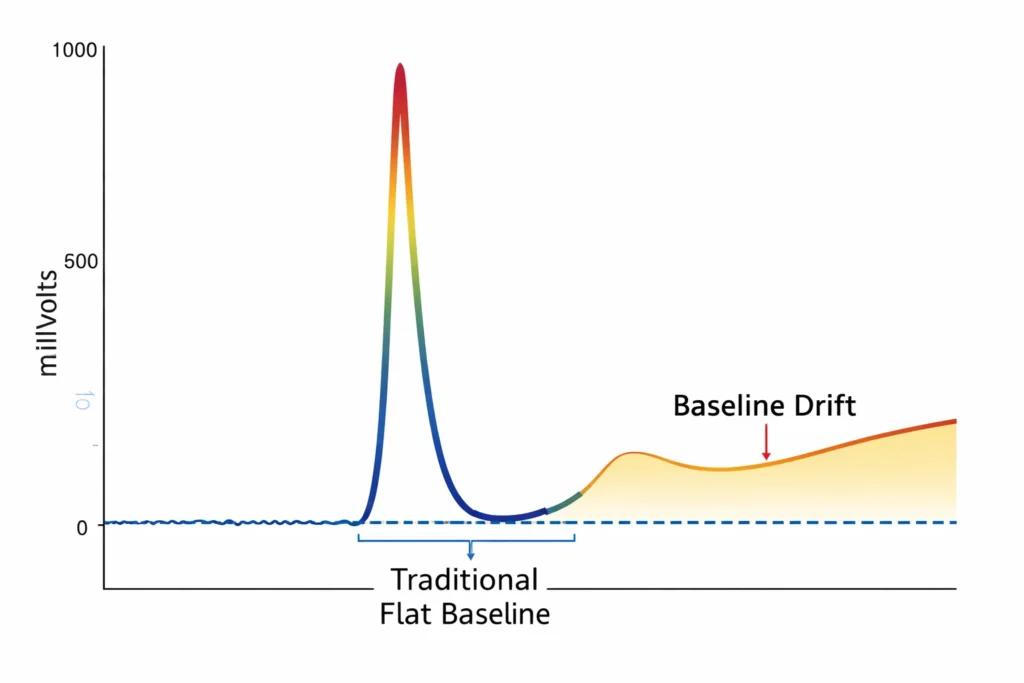
2. What Is the Sample Solvent Effect in HPLC?
The sample solvent effect in HPLC refers to the influence that the injection solvent has on chromatographic behavior, particularly on peak shape, retention, and separation efficiency.
In a well-optimized HPLC method, the sample should ideally be dissolved in a solvent that is equal to or weaker than the starting mobile phase. This allows analytes to be properly retained and focused at the top of the analytical column immediately after injection.
However, problems arise when the sample is dissolved in a stronger solvent than the mobile phase. This is commonly known as solvent mismatch or strong solvent effect.
For example:
- Sample solvent: 100% acetonitrile
- Initial mobile phase: 90% water / 10% acetonitrile
In this situation, the injected sample enters the column in an environment that is much stronger than the mobile phase. Instead of being retained and concentrated at the column inlet, the analytes may begin moving too quickly through the stationary phase. This disrupts the normal focusing process and negatively affects the chromatographic profile.
The sample solvent effect is particularly important in:
- Reversed-phase HPLC/UHPLC
- Small particle columns
- Short columns
- Low retention analytes
- High organic sample matrices
- Large injection volume methods
In practical terms, the sample solvent effect is not simply a “solvent issue” — it is a chromatographic band focusing issue that directly impacts separation quality.

3. How Sample Solvent Mismatch Distorts Peak Shape
When the sample solvent is too strong relative to the initial mobile phase, the injected analytes are not properly focused at the head of the column. This causes the sample band to spread too early, which directly affects chromatographic peak shape.
The most common peak distortions caused by sample solvent mismatch include:
Peak Fronting
Peak fronting occurs when the analyte moves too quickly through the front portion of the column due to strong solvent conditions. This causes the peak to lean forward or lose its symmetrical shape.
Peak Broadening
Instead of remaining tightly focused, the analyte band disperses before proper separation occurs. This results in wider peaks, lower sensitivity, and reduced separation efficiency.
Peak Splitting
In more severe mismatch conditions, the analyte may partially focus and partially migrate, producing split or doubled peaks. This can make interpretation and integration difficult.
Poor Early-Eluting Peak Resolution
Compounds that elute close to the void volume are especially sensitive to sample solvent mismatch. These peaks often suffer the most from poor shape and low resolution.
Retention Time Instability
Strong injection solvent can alter how quickly compounds begin moving through the stationary phase, causing retention time variability from run to run.
In UHPLC systems, where columns are shorter and particle sizes are smaller, these effects can become even more pronounced. Even relatively small differences between the sample solvent and mobile phase can lead to visible chromatographic distortion.
For this reason, solvent mismatch should always be considered when evaluating poor peak shape in HPLC.
4. What Causes Strong Solvent Effects in HPLC?
A strong solvent effect occurs when the sample diluent is chromatographically stronger than the initial mobile phase, especially at the moment of injection.
Several practical factors can contribute to this problem:
1. The Sample Is Dissolved in a Strong Organic Solvent
This is the most common cause. Samples are often prepared in:
- 100% ACN
- 100% MeOH
- DMSO
- IPA
- Strong organic extraction solvents
These solvents may be necessary for solubility, but they can also create severe mismatch with water-rich mobile phases.
2. Injection Volume Is Too Large
Even if the sample solvent is only moderately strong, a large injection volume can introduce enough strong solvent into the system to disturb the focusing process.
This is particularly problematic in:
- UHPLC methods
- Narrow-bore columns
- Short columns
- Highly sensitive separations
3. The Initial Mobile Phase Is Too Weak
Methods that begin with a very aqueous mobile phase are more vulnerable to strong solvent effects, especially if the sample is prepared in a highly organic solvent.
4. The Analyte Has Low Retention
Compounds with weak retention on the stationary phase are more likely to be affected by injection solvent strength because they are already difficult to focus at the column inlet.
5. Sample Preparation Prioritizes Solubility Over Chromatographic Compatibility
In real-world lab workflows, analysts often prepare samples in the solvent that dissolves them best — not necessarily the solvent that works best for chromatography.
This is understandable, but it can create an immediate trade-off between solubility and peak quality.
Ultimately, strong solvent effects are not caused by the solvent alone — they occur when sample preparation and chromatographic conditions are not properly aligned.
5. Common Signs of Solvent Mismatch in HPLC Chromatograms
Solvent mismatch is often easier to recognize in the chromatogram than in the method itself. In many cases, the HPLC system, column, and detector may all appear to be functioning normally, but the chromatographic peaks still look poor.
Below are some of the most common signs that your method may be suffering from sample solvent effects:
Fronting Peaks
A strong sign that the sample solvent may be too strong for the initial mobile phase.
Broad or Flattened Peaks
Peaks appear wider than expected and may show reduced height or poor sensitivity.
Split Peaks
The analyte may appear as two partially separated signal components instead of one clean peak.
Poor Resolution for Early Peaks
Compounds eluting near the beginning of the chromatogram may overlap or lose definition.
Inconsistent Retention Time
Retention time may shift slightly between injections, especially for early-eluting compounds.
Reduced Quantitative Reproducibility
Peak area and peak shape may vary from injection to injection, even if the sample concentration is stable.
Unexpected Changes When Injection Volume Increases
If peak shape becomes worse as injection volume increases, solvent mismatch may be a likely cause.
These symptoms are often mistakenly attributed to:
- Column damage
- Contamination
- Mobile phase issues
- Detector instability
While those factors can also affect chromatography, solvent mismatch should always be considered early in the troubleshooting process — especially if the sample is dissolved in a strong organic solvent.
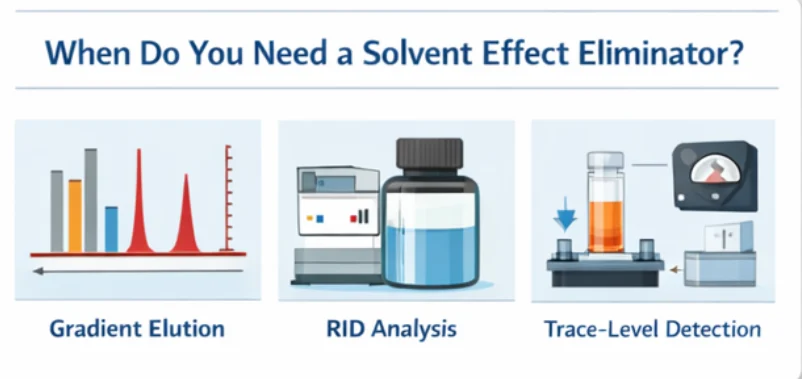
6. How to Reduce Sample Solvent Effects in HPLC
The good news is that solvent effects can often be reduced or eliminated with proper method optimization and sample preparation.
Here are the most effective strategies:
1. Match the Sample Solvent to the Initial Mobile Phase
This is usually the best solution whenever possible. If the mobile phase starts at a high aqueous ratio, try dissolving or diluting the sample in a solvent composition that is closer to that starting condition.
2. Use a Weaker Injection Solvent
If full mobile phase matching is not practical, use a weaker or more balanced solvent system that still maintains analyte solubility while improving chromatographic compatibility.
3. Reduce Injection Volume
Smaller injection volumes reduce the amount of strong solvent entering the column and can significantly improve peak shape.
4. Modify the Initial Gradient Conditions
In some cases, slightly increasing the initial organic content of the mobile phase can help reduce mismatch effects — although this may also affect retention and separation.
5. Improve Sample Dilution Strategy
If the sample must first be dissolved in a strong solvent, a secondary dilution step may help reduce the overall solvent strength before injection.
6. Use a Solvent Effect Eliminator or Focusing Device
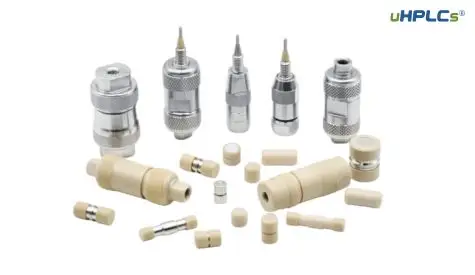
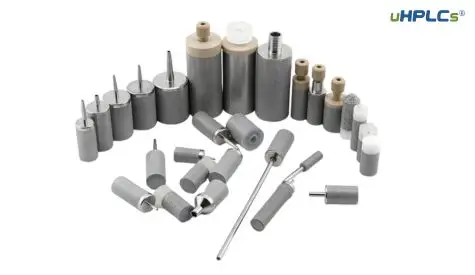
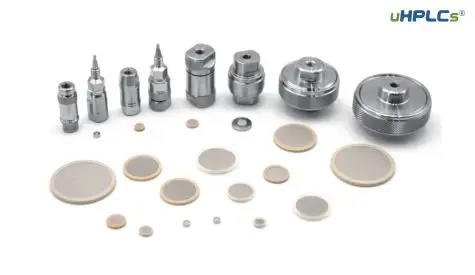
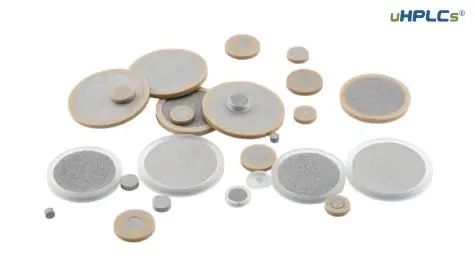
When sample solubility requirements prevent ideal solvent matching, an inline device can help reduce the impact of strong injection solvent before the analytes enter the analytical column.
This is especially useful in methods where:
- sample solvent cannot be changed
- analytes require strong organic dissolution
- peak shape is critical
- reproducibility is essential
In practice, the best solution depends on balancing sample solubility, analyte stability, and chromatographic performance.
7. What Is a Solvent Effect Eliminator and When Should You Use One?
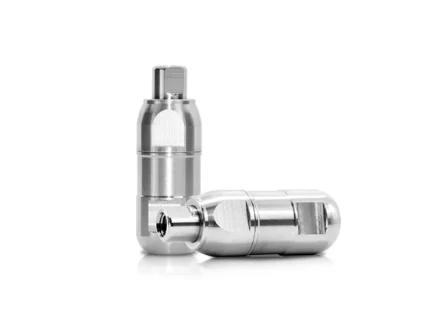
A solvent effect eliminator is a device designed to reduce the negative impact of sample solvent mismatch before the sample reaches the analytical column.
Its main purpose is to help restore better chromatographic focusing when the injected sample is dissolved in a solvent that is stronger than the starting mobile phase.
In practical terms, a solvent effect eliminator can help:
- improve peak symmetry
- reduce peak broadening
- minimize fronting or splitting
- improve reproducibility
- support better separation for early-eluting compounds
This type of device is especially useful when:
You Cannot Easily Change the Sample Solvent
Some compounds require strong organic solvents for complete dissolution.
You Work with High-Organic Sample Matrices
For example:
- extracted pharmaceutical samples
- impurity standards
- high-concentration stock solutions
- difficult-to-dissolve compounds
You Need Better Peak Shape Without Rebuilding the Entire Method
In some workflows, changing the mobile phase, gradient, or sample prep is not always practical. An inline solution may provide a more efficient way to improve chromatographic behavior.
You Are Working in UHPLC Conditions
UHPLC methods are generally more sensitive to injection solvent mismatch due to lower system volumes and smaller column dimensions.
A solvent effect eliminator should not be viewed as a substitute for good method development, but it can be a highly effective tool when sample solubility and chromatographic compatibility are difficult to balance.
8. FAQ About Sample Solvent Effects in HPLC
What is the solvent effect in HPLC?
The solvent effect in HPLC refers to the influence that the sample injection solvent has on chromatographic performance, especially peak shape, retention, and resolution. It becomes problematic when the sample solvent is stronger than the initial mobile phase.
What is solvent mismatch in HPLC?
Solvent mismatch occurs when the sample is injected in a solvent that is not chromatographically compatible with the starting mobile phase. This can prevent proper analyte focusing and cause distorted peaks.
Why does strong sample solvent cause peak broadening?
A strong sample solvent can cause the analyte band to spread too early instead of being retained and concentrated at the head of the column. This leads to broader peaks and reduced efficiency.
Can sample solvent affect retention time?
Yes. In some cases, especially for early-eluting compounds, sample solvent mismatch can shift or destabilize retention time.
Should the sample solvent match the mobile phase?
Ideally, yes. The sample solvent should be similar to or weaker than the initial mobile phase whenever possible to support proper chromatographic focusing.
What is the best injection solvent for reversed-phase HPLC?
The best injection solvent is usually one that is close in strength to the starting mobile phase while still maintaining adequate sample solubility.
How do you reduce solvent effects in HPLC?
Common solutions include matching the sample solvent to the mobile phase, reducing injection volume, adjusting the gradient, using weaker diluents, or adding a solvent effect eliminator.
When should I use a solvent effect eliminator?
You should consider using one when sample solvent mismatch is affecting peak shape and changing the sample preparation or method conditions is not practical.