
HPLC / UHPLC Solvent Effect Solution
Peak Smooth Column for HPLC Sample Solvent Mismatch
Reduce peak splitting, fronting and broadening caused by injection solvent effects and sample diluent / mobile phase mismatch.
A hardware-based approach for chromatographic methods where changing the sample solvent, reducing injection volume or reconstituting the sample is impractical.
- HPLC / UHPLC Compatible
- Easy Inline Installation
- OEM & Custom Options
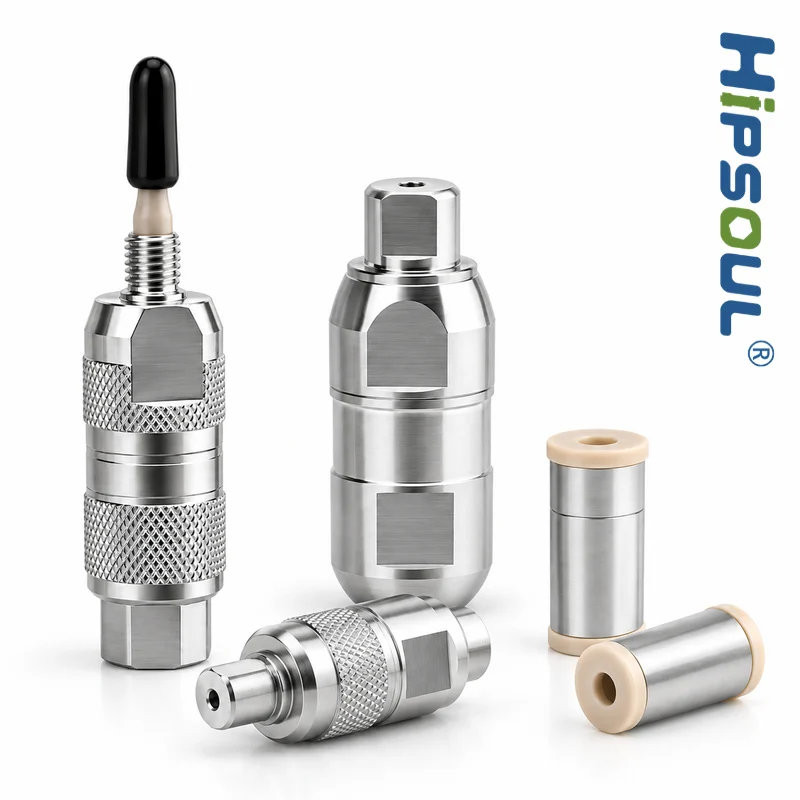
Are Your HPLC Peak Problems Caused by the Sample Solvent?
Poor peak shape does not always mean the analytical column is damaged.
Peak splitting
A split or doubled peak after injection, often worse for early-eluting compounds.
Peak fronting
The peak leans forward when the inlet band is not focused cleanly.
Peak broadening
Wider, lower peaks when the sample plug spreads before the column can focus it.
Shoulder peaks
A shoulder on the main peak can appear when part of the plug migrates ahead of the focused band.
Poor early-eluting peak resolution
Compounds near the void are usually the first to show injection solvent mismatch.
- Sample Solvent
- Injection
- Solvent Mismatch
- Poor Focusing
- Peak Distortion
When the sample diluent differs significantly from the initial mobile phase in solvent strength, composition or compatibility, analytes may not focus properly at the column inlet.
These chromatogram patterns can also come from column overload, contamination, extra-column volume, poor fittings, column damage or secondary interactions. Other HPLC system, column and method factors should also be ruled out during troubleshooting.
What Is the Sample Solvent Effect in HPLC?
The sample solvent effect in HPLC is the influence of the injected sample diluent on analyte focusing, transfer and early retention when that diluent differs from the initial mobile phase.
The sample solvent temporarily becomes part of the chromatographic environment during injection. If it differs substantially from the initial mobile phase, analytes entering the analytical column can experience different solvent environments. That can alter focusing, migration and retention behavior at the column inlet. Laboratories also describe this as an injection solvent effect, a strong solvent effect, or sample diluent mismatch.
- Sample diluent
- Initial mobile phase
- Sample Vial
- Injector
- Sample Plug
- Mobile Phase
- Analytical Column
- Mismatch → Distorted sample band
- Match → Focused sample band
A longer technical discussion is in sample solvent effects in HPLC.
Why Sample Solvent / Mobile Phase Mismatch Causes Peak Distortion
Sample solvent effects occur when the injected sample diluent differs sufficiently from the initial mobile phase to alter analyte focusing, transfer or retention at the column inlet.
Solvent strength difference
A sample diluent stronger than the initial mobile phase may reduce analyte focusing at the column inlet.
Solvent compatibility
Poor miscibility or composition differences can disrupt sample transfer into the mobile phase.
Analyte solubility
The analyte may behave differently in the sample diluent and initial mobile phase.
Molecular / ionic state
Changes in ionization or molecular state between the sample solvent and mobile phase can affect retention behavior.
Traditional Ways to Reduce HPLC Solvent Effects
Reduce injection volume
Less diluent enters the column, which often improves focusing at the cost of sensitivity.
Match sample diluent to mobile phase
Still the preferred approach whenever the method and solubility allow it.
Dilute the sample
A secondary dilution can lower organic strength before injection if concentration still meets the method.
Evaporate and reconstitute
Useful when extracts are too strong, but it adds sample-preparation time and handling risk.
These approaches are not always practical.
- Validated methods may restrict method changes
- Sample solubility may be poor in the initial mobile phase
- Analytes may be less stable in aqueous mobile phases
- SPE / QuEChERS extracts may contain high organic solvent levels
- Evaporation and reconstitution increase sample-preparation time
- Reducing injection volume may sacrifice sensitivity
A Hardware Approach to Sample Solvent Mismatch
Meet the uHPLCs Peak Smooth Column
The Peak Smooth Column is installed in the flow path between the injector and analytical column. It is designed to moderate the differences between the injected sample solvent environment and the initial mobile phase before the sample reaches the analytical column.
It is a specialized flow-path device for peak-shape problems associated with sample solvent / mobile-phase mismatch and injection solvent effects. It is not an analytical column, and it is not positioned as a stationary phase that removes secondary interactions.
- Reduce injection solvent effects in suitable methods
- Improve peak symmetry when mismatch is the cause
- Reduce solvent-related peak splitting
- Reduce solvent-related fronting and broadening
- Support larger injection volumes in suitable methods
- Reduce the need for evaporation and reconstitution in suitable workflows
- Support more consistent sample introduction when the method cannot change
Results depend on analyte chemistry, diluent, mobile phase, injection volume, column dimensions and system volume. This page does not claim that the hardware eliminates all peak problems or works for every method.
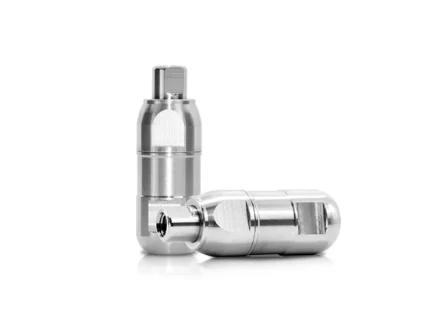
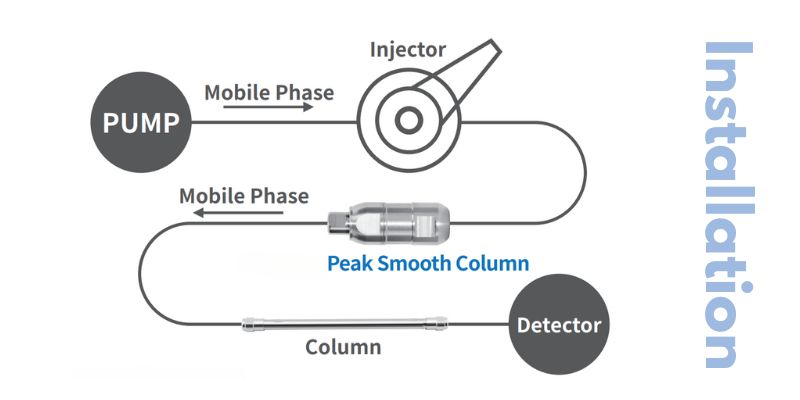
How the Peak Smooth Column Works
- Mobile Phase
- Pump
- Injector
- Peak Smooth Column
- Analytical Column
- Detector
Flow direction: injector → Peak Smooth Column → analytical column. It is not installed in the solvent bottle and not upstream of the injector.
Sample injection
The sample plug enters the flow path from the injector.
Solvent environment moderation
The Peak Smooth Column helps reduce abrupt differences between the sample diluent and mobile phase environment.
Improved column entry
The sample reaches the analytical column under a more favorable chromatographic environment when mismatch was the limiting factor.
See the Difference in Peak Shape
Before: sample solvent mismatch
Split, fronting or broad peaks can appear when the injection solvent is stronger or incompatible with the initial mobile phase.
After: with Peak Smooth Column
In suitable methods, peaks may become sharper, more symmetrical and better focused. Improvement is not guaranteed for every chromatogram.
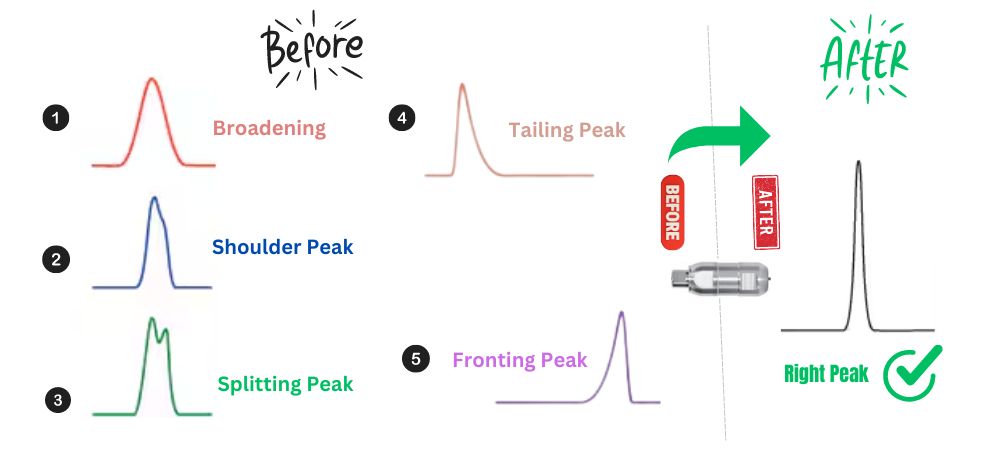
Illustrative chromatograms. Actual improvement depends on analyte chemistry, sample solvent, mobile phase composition, injection volume, column dimensions and chromatographic conditions. The image on this page is a product illustration, not a numbered experimental report.
Choose the Right Peak Smooth Column
Solutions for conventional HPLC and high-pressure UHPLC workflows.
Models below are taken from the current solvent-effect eliminator catalog. Connection thread, housing material and PEEK / bio-compatible variants are not listed on that table and are confirmed on the RFQ.
Direct-connect Peak Smooth Column
Type: Direct-connect
Maximum pressure: 80 MPa
Internal volume: 25 / 47 / 58 μL
Recommended system: Conventional HPLC
Models: P3F0B-00382, P3F0B-00383, P3F0B-00336
Connection / material: Request specifications
Inline hardware for HPLC methods within the listed 80 MPa rating.
Rotary Peak Smooth Column
Type: Rotary
Maximum pressure: 100 MPa
Internal volume: 25 / 47 / 58 μL
Recommended system: HPLC / UHPLC
Models: P3F0B-00320, P3F0B-00352, P3F0B-00349
Connection / material: Request specifications
Rotary body for higher-pressure HPLC and UHPLC workflows within 100 MPa.
Compact rotary Peak Smooth Column
Type: Compact rotary
Maximum pressure: 100 MPa
Internal volume: 25 / 47 / 58 μL
Recommended system: High-pressure UHPLC
Models: P3F0B-00384, P3F0B-00385, P3F0B-00370
Connection / material: Request specifications
Smaller rotary body listed at 100 MPa for compact high-pressure layouts.
| Model | Application | Maximum pressure | Internal volume | Connection | Recommended system | Action |
|---|---|---|---|---|---|---|
| P3F0B-00382 | Direct-connect Peak Smooth Column | 80 MPa | 25 μL | Request specifications | Conventional HPLC | Request specifications |
| P3F0B-00383 | Direct-connect Peak Smooth Column | 80 MPa | 47 μL | Request specifications | Conventional HPLC | Request specifications |
| P3F0B-00336 | Direct-connect Peak Smooth Column | 80 MPa | 58 μL | Request specifications | Conventional HPLC | Request specifications |
| P3F0B-00320 | Rotary Peak Smooth Column | 100 MPa | 25 μL | Request specifications | HPLC / UHPLC | Request specifications |
| P3F0B-00352 | Rotary Peak Smooth Column | 100 MPa | 47 μL | Request specifications | HPLC / UHPLC | Request specifications |
| P3F0B-00349 | Rotary Peak Smooth Column | 100 MPa | 58 μL | Request specifications | HPLC / UHPLC | Request specifications |
| P3F0B-00384 | Compact rotary Peak Smooth Column | 100 MPa | 25 μL | Request specifications | High-pressure UHPLC | Request specifications |
| P3F0B-00385 | Compact rotary Peak Smooth Column | 100 MPa | 47 μL | Request specifications | High-pressure UHPLC | Request specifications |
| P3F0B-00370 | Compact rotary Peak Smooth Column | 100 MPa | 58 μL | Request specifications | High-pressure UHPLC | Request specifications |
Bio-compatible / PEEK hardware is not in the current nine-model table. If a PEEK or inert flow path is required, send the system and wetted-material constraint with the RFQ.
Where Peak Smooth Columns Can Help
Pharmaceutical QC
Useful when validated or compendial methods limit changes to sample preparation or diluent composition.
Analytical method development
Evaluate and troubleshoot sample solvent effects during method optimization.
Food safety testing
Support workflows involving high-organic sample extracts.
Pesticide residue analysis
Useful for SPE / QuEChERS extracts where solvent mismatch may affect LC peak shape.
LC-MS / LC-MS/MS
Improve sample introduction conditions in solvent-sensitive workflows where appropriate.
CRO / contract laboratories
Reduce troubleshooting time across diverse methods and sample matrices.
Is Your Peak Problem Really a Solvent Effect?
If several of these conditions apply, sample solvent mismatch should be investigated.
- Peak shape worsens as injection volume increases
- Sample is dissolved in high-organic solvent
- Initial mobile phase is highly aqueous
- Peak shape improves when using initial mobile phase as sample diluent
- Peak shape improves after reducing injection volume
- Early-eluting compounds are most affected
- Evaporation and reconstitution improves the chromatogram
Peak Smooth Column vs Traditional Solvent-Effect Solutions
Matching the sample diluent to the initial mobile phase remains one of the preferred solutions whenever practical. The Peak Smooth Column is positioned as an alternative when changing the sample preparation or chromatographic method is difficult.
| Solution | Method change | Sample prep time | Sensitivity impact | Hardware required |
|---|---|---|---|---|
| Reduce injection volume | Yes | Unchanged | May reduce signal | No |
| Change sample diluent | Yes | May increase if re-validated | Depends on solubility | No |
| Evaporate and reconstitute | Yes | Increases | Can concentrate or lose analyte | No |
| Peak Smooth Column | Usually none to the validated method | Unchanged | May allow a practical injection volume | Yes |
Why Choose uHPLCs for HPLC Solvent-Effect Solutions?
Chromatography hardware expertise
Peak Smooth Columns sit with Ghost Buster Columns, guard columns and inline filters as HPLC flow-path hardware, not as a generic packed analytical column family.
HPLC and UHPLC pressure options
Catalog ratings are 80 MPa for direct-connect bodies and 100 MPa for rotary and compact rotary bodies.
OEM / private label
Custom connections, labeling and drawings can be evaluated after the target system and pressure are known.
Custom connections
Thread, port and compact rotary layouts are quoted from the existing catalog type plus your fitting requirement.
Application support
Send a chromatogram, sample solvent, mobile phase and injection volume for a solvent-mismatch review.
Low MOQ for evaluation
Evaluation quantities can be discussed on the RFQ. Named production-area or staff figures are not published on this page.
HPLC Sample Solvent Effect FAQs
What is the solvent effect in HPLC?
The solvent effect in HPLC is the influence of the injected sample diluent on peak shape, focusing and early retention. It becomes a problem when that diluent differs enough from the initial mobile phase to change how analytes enter the analytical column. The result can be splitting, fronting, broadening or unstable early peaks. Matching the diluent to the starting mobile phase is the preferred fix when the method allows it.
What causes sample solvent mismatch in HPLC?
Sample solvent mismatch occurs when the injection solvent differs from the initial mobile phase in elution strength, composition or miscibility. Common cases include dissolving the sample in acetonitrile, methanol or an SPE/QuEChERS extract while the gradient starts in a highly aqueous mobile phase. Large injection volume, weakly retained analytes and short UHPLC columns make the mismatch more visible. Other hardware and method issues should still be ruled out.
Can a strong sample solvent cause peak splitting?
Yes. A sample diluent stronger than the initial mobile phase can prevent the analyte from focusing as a single band at the column inlet. Part of the plug may start migrating while the rest is still transferring, which can produce split or shouldered peaks, especially for early-eluting compounds. Split peaks also have other causes, including extra-column volume, poor fittings and column damage, so solvent mismatch should be confirmed rather than assumed.
Why does acetonitrile cause poor peak shape in HPLC?
Acetonitrile is a strong reversed-phase solvent. If the sample is dissolved in a high acetonitrile fraction and the method starts with a water-rich mobile phase, the injection plug can reduce focusing at the column head. That injection solvent effect may show as fronting, broadening or splitting. The issue is the mismatch with the initial mobile phase, not acetonitrile as a mobile-phase solvent. Diluting toward the starting composition, reducing injection volume, or evaluating a Peak Smooth Column are typical options.
Can sample solvent cause peak fronting?
Sample solvent can contribute to peak fronting when a strong diluent carries analyte too far into the column before proper focusing. Fronting also has other causes, including overload and secondary interactions, so it is not proof of solvent mismatch by itself. Useful checks include reducing injection volume, injecting a dilution in the initial mobile phase, and seeing whether early peaks improve. The Peak Smooth Column is intended only for the solvent-mismatch subset of fronting problems.
Why does reducing injection volume improve peak shape?
A smaller injection introduces less sample diluent into the flow path, so any solvent-strength difference has less effect on the inlet band. If peaks sharpen after a volume reduction, injection solvent effects should be investigated. The trade-off is sensitivity. When the validated method cannot reduce volume or change the diluent, a Peak Smooth Column can be evaluated as hardware between the injector and analytical column.
Should the sample solvent match the mobile phase?
Whenever practical, the sample diluent should match or be weaker than the initial mobile phase so analytes focus at the column inlet. That remains a preferred solution. It is not always practical: some analytes dissolve poorly in aqueous starters, some extracts are high in organic solvent, and some validated methods restrict sample-preparation changes. In those cases, a hardware approach such as the Peak Smooth Column can be discussed without rewriting the method first.
What is sample diluent incompatibility in HPLC?
Sample diluent incompatibility means the injection solvent does not mix, transfer or focus well with the initial mobile phase. It covers solvent-strength mismatch, poor miscibility and cases where the analyte’s solubility or ionic state differs between the vial and the column inlet. The chromatogram may show distortion even when the column and detector are intact. Compatibility is assessed from diluent composition, starting mobile phase, injection volume and which peaks are affected.
How can I reduce strong solvent effects without changing the sample diluent?
If the diluent cannot change, first confirm that the peak issue tracks injection volume and early-eluting peaks. Reducing injection volume is the simplest method change. When volume, reconstitution or diluent matching is not practical, a Peak Smooth Column installed after the injector can be evaluated to moderate the sample-solvent environment before the analytical column. It does not replace diagnosis of overload, contamination, extra-column volume or secondary interactions.
What is a Peak Smooth Column?
A Peak Smooth Column is a flow-path device installed between the injector and the analytical column. It is offered as hardware for HPLC sample solvent mismatch and injection solvent effects, not as a replacement analytical column and not as a cure for every peak-shape problem. Catalog types are direct-connect (80 MPa) and rotary / compact rotary (100 MPa), each in 25, 47 and 58 μL internal volumes. Connection details are confirmed from the RFQ when they are not listed on this page.
Where is the Peak Smooth Column installed?
Install it in the high-pressure flow path after the injector and before the analytical column, in the direction of flow. It is not a reservoir inlet filter, not a Ghost Buster Column (those sit upstream of the injector for mobile-phase ghost peaks), and not a conventional guard column. Follow the fitting orientation for the selected direct-connect or rotary body and stay within the listed pressure rating.
Can a Peak Smooth Column be used with UHPLC?
Use a catalog option whose listed pressure covers the method. Rotary and compact rotary models P3F0B-00320, P3F0B-00352, P3F0B-00349, P3F0B-00384, P3F0B-00385 and P3F0B-00370 are listed at 100 MPa. Direct-connect models are listed at 80 MPa and should not be used above that rating. Confirm fittings, extra-column volume and the analytical-column ID with the RFQ for a UHPLC layout.
Can it be used for LC-MS/MS?
It can be evaluated in solvent-sensitive LC-MS or LC-MS/MS workflows where injection solvent mismatch is suspected and method changes are limited. Suitability depends on pressure, fittings, extra-column volume, ionization and whether the peak issue is actually a solvent effect. Send the system, column, mobile phase, sample solvent, injection volume and a chromatogram. This page does not claim a universal LC-MS result.
How do I know whether my peak problem is caused by solvent mismatch?
Solvent mismatch is more likely when peak shape worsens as injection volume increases, the sample is in a high-organic diluent, the initial mobile phase is highly aqueous, early-eluting peaks are worst, or the chromatogram improves after diluting in the starting mobile phase. If those checks fail, look at overload, contamination, extra-column volume, fittings, column damage and secondary interactions. Send a chromatogram and method conditions for a Peak Smooth Column review rather than assuming the hardware will correct every distortion.
Learn More About HPLC Peak Troubleshooting
Sample solvent and peak shape
Read sample solvent effects in HPLC for focusing, strong-solvent checks and method options.
HPLC peak shape troubleshooting
Broader peak-shape issues that are not limited to diluent mismatch: HPLC peak shape troubleshooting.
Also: fronting peaks and peak splitting.
Related hardware
HPLC guard columns protect the analytical column from sample debris. HPLC inline filters trap particles in the flow path. Ghost Buster Columns target mobile-phase ghost peaks before the injector.
Still Fighting Split, Fronting or Broad HPLC Peaks?
Send us your chromatogram, sample solvent, mobile phase and injection conditions. Our team can help evaluate whether sample solvent mismatch may be contributing to the problem.
Prefer email? [email protected]